Came across a few good video teaching jazz last week via FB and email newsletter.
First, my favorite guitarist Alex Skolnick from Testament taught a few jazz licks over various chords (ii-V, I, Valt) I play his Valt (altered dominant 7th) lick in my solo all the time :P
Then I watched this video by online jazz teacher Jamie Holroyd teaching how to jazz up the chord progression of the Oasis big hit "Wonderwall"
Thursday, April 24, 2014

Tuesday, March 11, 2014
Kansas City Lightning
It was around X'mas 2013 and I wanted to know what were the best recommended books from 2013. Found this list but it was all novels. Then I went on Amazon and it recommended this book by Stanley Crouch about Charlie
Parker's days in KC. I downloaded the intro and eventually borrowed the book from the library for two months. (It's ~330 pages and not exactly a page turner so it took me a long time to finish :P I did read 130 pages in 5 days right before the due date) To be honest, I am kinda biased against the author's work because he has a tendency to relate everything to race, e.g. what happened to whom because he was African American or not. And it affected how he favored some jazz musicians/music over others. With that in mind, I still find it valuable to know what happened in USA during the 1st half of the 20th century in the social context of African American. It did explain the origins of some elements of jazz, and the social background from which jazz was emerged: a politically corrupted city allowed entertainment venues to thrive, which in turns allowed musicians to prosper (and honed their craft via experimentation with others.) There were tons of dramas in Charlie Parker's life too: drug addiction, how he met his first wife (whose family subleased from the Parker's) and how they separated, his move to Chicago and New York and back. My timing of reading this book couldn't be better since I am also studying Parker's improvisation lines.
BTW, I read some reviews recommended that audiobook was ideal for it. In fact, I think Hollywood could make a good movie out of it (starring Bruno Mars as Charlie Parker? I don't think Crouch would approve :P)
BTW, I read some reviews recommended that audiobook was ideal for it. In fact, I think Hollywood could make a good movie out of it (starring Bruno Mars as Charlie Parker? I don't think Crouch would approve :P)
Tuesday, March 04, 2014
Superstar Quartet, the Strat Pack
After a busy week of recording our jazz trio, my life is back to normal, i.e., more listening to others than ourselves. I was free on Friday night so the first choice was a good jazz concert and I heard on the radio that legendary vibraphonist Bobby Hutcherson and saxophonist David Sanborn were performing together (along with organist Joey DeFrancesco and drummer Billy Hart) at SFJAZZ. Small problem though: I have not been able to purchase tickets on SFJAZZ's official website (had the same problem when Paquito D'Rivera played there last time) The error message was ambiguous: something like tickets were for members only or soldout. Unlike last time though, the box office opens on Friday so I called and bought (according to the ticket office guy) the last ticket available. It was expensive but I went with my impulse and it turned out to be good seat: first row of the 2nd closest section in the middle! And of course the sound was unique: I am familiar with each musician from different sub-genre: Bobby Hutcherson from modern jazz, David Sanborn from smooth jazz/R&B, and Joey D from soul jazz. Most importantly, they sounded great together! I'd say the sound was more fusion-oriented but that's certainly my cup of tea. A couple of funny things from the concerts: 1) they were billed as the 'Superstar quartet' What an unimaginative name for such a creative group! 2) when Joey D introduced the tune they just performed, called "You" and said he wrote it for Hutcherson. The latter acted surprised and delighted. What was funnier was next: one guy from the audience asked about the previous tune, this time Sanborn responded 'coz it's written by him. Hutcherson asked whether it was also dedicated to him. Sanborn said no though :)
I was flipping channel on cable on Sunday night and the Palladium channel was showing a program called Strat Pack. I was curious and switched to it and saw the late Gary Moore covering Jimi Hendrix's tunes. As always, he's got the blues! I found out it's a concert with various musicians for celebrating the 50th anniversary of the creation of the Fender Stratocaster guitar. Oh well, I'm not sure what singer/pianist Jamie Cullum has to do with the Strat. His band didn't even feature guitar! Next was the late Amy Winehouse. I had no idea she played too but she did play a red Strat (just like my buddy!) and accompanied herself on one tune. Not exactly great playing but as usual, she's got style! The other part of the concert that I liked was when David Gilmour played a few old Pink Floyd songs, including "Sorrow", which was my favorite Pink Floyd tunes during the 80s. It was one of the hardest rocking Pink Floyd tunes IMO. I didn't know a lot of fans like it too. To be honest, I was not impressed by the rest of the performers. They've got the guy from Bad Company and the Eagles. Even Brian May (but he's not known for playing the Strat!) This year is the 60th anniversary and hopefully they've got a stronger lineup to celebrate this. Maybe some of the guys mentioned on Fender's page!
I was flipping channel on cable on Sunday night and the Palladium channel was showing a program called Strat Pack. I was curious and switched to it and saw the late Gary Moore covering Jimi Hendrix's tunes. As always, he's got the blues! I found out it's a concert with various musicians for celebrating the 50th anniversary of the creation of the Fender Stratocaster guitar. Oh well, I'm not sure what singer/pianist Jamie Cullum has to do with the Strat. His band didn't even feature guitar! Next was the late Amy Winehouse. I had no idea she played too but she did play a red Strat (just like my buddy!) and accompanied herself on one tune. Not exactly great playing but as usual, she's got style! The other part of the concert that I liked was when David Gilmour played a few old Pink Floyd songs, including "Sorrow", which was my favorite Pink Floyd tunes during the 80s. It was one of the hardest rocking Pink Floyd tunes IMO. I didn't know a lot of fans like it too. To be honest, I was not impressed by the rest of the performers. They've got the guy from Bad Company and the Eagles. Even Brian May (but he's not known for playing the Strat!) This year is the 60th anniversary and hopefully they've got a stronger lineup to celebrate this. Maybe some of the guys mentioned on Fender's page!
Friday, February 14, 2014
我的結他雜記: Recording jazz guitar trio
Like any musician/bands, we recorded ourselves during rehearsals all the time, usually with a cellphone or better yet, a camera/camcorder with a decent mic. As we are preparing a demo of pieces we would like to perform, we decided to go slightly higher-end this time: recording with an amp sim/interface (KORG Pandora), a condenser mic (Samson Go mic) and a notebook PC (ASUS X200CA) I also brought a few USB cables, long extension cords for USB and headphone and a HK electrical outlet adapter for my US computer power supply.
The recording session took place at 310 Studio in the "legendary" Mong Kok 先施大厦. We were given the first room which was the best option for us since only one side is adjacent to another room so we kinda limited the amount of unwanted sound picked up by our mic. There was a mixer in the room connected to studio monitors. We ended up recorded our tunes like this:
1) Load the Audacity file on which a click track was generated and I pre-recorded the guitar part at home already.
For the bass, lower the volume of the click track. We plugged the bass into the Pandora and chose the 'B JAZZ' preset. Then connected the output of Pandora to the in-room mixer. Our bassist listened to the studio monitor and played his part. Set Audacity to use the Pandora as the input.
For the drums, lower the volume of the guitar track. We used the USB extension cable and clipped the Samson Go mic up on one of the mic stand extended all the way up. Set Audacity to use it as the input and the computer as the output. Finally, plug the headphone with extension cable to the computer. Our drummer listened to the headphone and played. He could not take advantage of the studio monitor because the mic would have picked that audio up.
Using this approach, i.e., each instrument on its own track, we were able to easily balance the volume of each instrument (basically cutting the drums and pumping up the guitar) and made them all sound clearly. We even cheated a little bit by lining up the notes perfectly :P
2) Open a blank Audacity file. Place the Samson Go mic roughly equal distance to the drums, the guitar amp and the bass amp. I relied on the 'Midtown Jazz' preset of the Pandora so I connected the output of Pandora to the Line 6 amp. Chose the Clean channel. Adjusted bass, mid, treble to "neutral" and recorded all 3 of us playing together on one track.
Using this approach, we lost the ability to balance the instruments. I wish the guitar sounded louder >:) On the other hand, the playing sounded much more cohesive since we were playing and listening to each other at the same time.
[Update] Found this article comparing the pros and cons written by a pro. The observations are similar.
[Update] Found this article comparing the pros and cons written by a pro. The observations are similar.
Thursday, January 30, 2014
我的結他雜記: 6th chord
I have been looking into the art of jazz comping on guitar these days and saw that the 6th chord is commonly used for substitution (C6 for Cmaj7 for example) And this is a good article on Jamie Holroyd's site that explains what 6th chords are and how to play them.
Monday, January 27, 2014
我的結他雜記: Jimmy Bruno and Herb Ellis method
I have been a fan of Jimmy Bruno's teaching (as well as playing) for a long time. I have watched his old instructional video "No Nonsense Jazz Guitar" years ago. At first I couldn't understand most of what he said (and still don't) but I did pick up a couple major scale fingering from it (those are commonly taught and proved to be useful) I re-watched the video and joined his "old" online school towards the end of it a few years ago for a few months. This time I picked up all of his 5 major scale fingerings and the ii-V-I arpeggios extracted from them (m7b5 arp could be extracted indirectly) It took a long time to got them under my fingers for all 12 keys though. I also got a better understanding in making single-note solo only based on all "inside" note of a key center (or pitch collection in Jimmy's terminology) by mixing up scale and arpeggio runs. The "understanding" didn't translate into the ability to come up with those lines on the fly though. I submitted a ii-V-I improv video trying to apply the principle and the result didn't really sound like jazz. Jimmy suggested me to listen carefully to the ii-V-I video submitted by other students and his responses. Too bad that's when the "old" school closed the door. I think part of what he wanted me to do was to transcribe the lines that sounded good and analyze them. Jimmy wasn't actually secretive about his method. A lot of the value of his online school lies in his feedback to my playing as well as the other students'.
I also had some experiences with Herb Ellis' method via his "All the Shapes You Are" book, part of his series of 3 method books. This volume presented 7 shapes. They are major triads, minor triads, dominant 7th and dominant 9th chords. For the shapes with major triads, there are 2 corresponding scale fingerings: major scale and dominant scale (i.e., the mixolydian mode) Some shapes have 1 dominant scale or 1 minor scale (actually dorian mode rather than natural/harmonic/melodic minor) If I understand it correctly (described in my old post), to use this method, pick an applicable "scale" over the chord you encounter during improv (obviously, major chord uses major scale, minor chord uses minor scale and dominant chord uses dominant scale) The shapes help identifying chord tones which should be emphasized in the line (e.g. start or end a phrase, or finish the line, especially for resolution to I chord) The bulk of the book consists of many example lines that demonstrate how Herb's method is to be applied, which the author merely suggested to try playing a few times and move on. I made a mistake of not analyzing and memorizing those lines at that point of my study. I was too lazy and thought I should come up with my own lines anyway but I couldn't (partly because I wasn't familiar with the fingerings enough) so I gave up on the method. Another reason why I didn't study those example lines was they are based on a single chord covering multiple bars. Real tunes usually modulate quickly, with ii-V-I in 2 bars often. I just couldn't imagine myself switching from one scale to another every 2 beats. (Later on I found out a phrase that "works" on a ii chord could also be played over the V in the ii-V and vice versa. So I could have "switched" less frequently)
I gotta admit I suffer from low JIQ (Jazz improvisation quotient) As my instructors would say, I didn't "speak" in the jazz language in my solo. To overcome this, I tried memorizing licks from various books by Joseph Alexander, Sid Jacob and Robert Conti. You could hear common phrases among all these licks and from actual solo played during performances or recordings. I am practicing playing these licks using Bruno's fingering
(5 shapes)
I also had some experiences with Herb Ellis' method via his "All the Shapes You Are" book, part of his series of 3 method books. This volume presented 7 shapes. They are major triads, minor triads, dominant 7th and dominant 9th chords. For the shapes with major triads, there are 2 corresponding scale fingerings: major scale and dominant scale (i.e., the mixolydian mode) Some shapes have 1 dominant scale or 1 minor scale (actually dorian mode rather than natural/harmonic/melodic minor) If I understand it correctly (described in my old post), to use this method, pick an applicable "scale" over the chord you encounter during improv (obviously, major chord uses major scale, minor chord uses minor scale and dominant chord uses dominant scale) The shapes help identifying chord tones which should be emphasized in the line (e.g. start or end a phrase, or finish the line, especially for resolution to I chord) The bulk of the book consists of many example lines that demonstrate how Herb's method is to be applied, which the author merely suggested to try playing a few times and move on. I made a mistake of not analyzing and memorizing those lines at that point of my study. I was too lazy and thought I should come up with my own lines anyway but I couldn't (partly because I wasn't familiar with the fingerings enough) so I gave up on the method. Another reason why I didn't study those example lines was they are based on a single chord covering multiple bars. Real tunes usually modulate quickly, with ii-V-I in 2 bars often. I just couldn't imagine myself switching from one scale to another every 2 beats. (Later on I found out a phrase that "works" on a ii chord could also be played over the V in the ii-V and vice versa. So I could have "switched" less frequently)
I definitely see similarities between both methods: in fact, the fingerings are very similar. You could even say all of Herb's major/minor/dominant fingering could be "merged" into Jimmy's 5 major fingerings (one or two needs very minor modifications like moving the 4th fingers to the 1st finger of next string. Jimmy doesn't like stretching over 4 frets on a single string in one position, for speed I guess) and all the chord tone shapes are subset of arpeggios extracted from Jimmy's fingerings (except the 9th in dominant 9th)
I'd say Jimmy's fingering are easier to apply in a ii-V-I context because you don't need to recall 3 of Herb's fingering in the same position of the neck. Instead, just recall one of the 5 Jimmy's major scale fingering and the 3 arpeggios within it.
Both of them taught the use of approach notes (half step from above and below chord tones) for chromaticism.
Tuesday, January 21, 2014
Fingerstyle guitar master Stefan Grossman
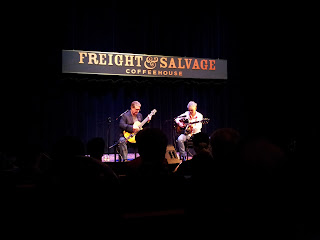
禮拜日無節目,也是當天才知道,幸好家在bay area,不愁沒有音樂會,基本上我的策略是先看KCSM Jazz datebook,以及一些著名演出場地的網址,包括Yoshi's, Freight and Salvage, Davies Symphony Hall等等。首先看到Freight and Salvage有acoustic fingerstyle guitar表演,然後看到SFJAZZ有一場拉美爵士樂,有我欣賞的古巴單簧管色士風大師Paquito D'Rivera,可惜SFJAZZ售票網及電話皆不通。兩全其美的方法:是去前者,在路上聽後者的CD!相當慶幸沒有錯過一場非一般的音樂會。
Freight and Salvage這個場地本身已是非一般牟利娛樂場所,而是一個歷史悠久,靠捐款由義工協助運作,以傳統美國音樂為主的表演中心。傳統美國音樂除了我常聽的Blues及Jazz,也包括我興趣不大的Country及Bluegrass。不過演出宣傳網頁介紹Stefan Grossman彈fingerstyle guitar,從結他手角度也絕對值得支持。提起fingerstyle,我聽得較多的有Tommy Emmanuel, Martin Taylor, Adam Miller(去年他首次從澳洲來美國巡迴演出,可惜Bay area一站是在偏遠的Lafayette,包括我在內的捧場客寥寥無幾)網頁上的Stefan Grossman sample track風格頗有不同,卻是我非常欣賞但不常聽到的Acoustic blues。音樂會打頭炮就是一首令人聽出耳油的acoustic blues instrumental。接著他開始他獨有的「棟篤笑」式表演:邊說邊唱邊彈地介紹自己學及玩結他的軼事,歌曲的出處等等。雖然個人偏好instrumental music,也覺得他的方式很是過癮。他是一個成長於Brooklyn的猶太人,小時候想學結他,父母叫他去買點唱片,他在唱片店買來一張folk(Woody Guthrie),一張acoustic blues唱片,決定走後者的路線,師從Reverend Gary Davis,學了一大堆廿世紀初至中的美國傳統歌曲,包括Mississippi John Hurt, Big Bill Broonzy等大師的作品。當晚表演也有原創,例如拿另一位acoustic blues 結他手開玩笑的Assassination of John Fahey,大概有三分二是instrumental,除了blues,也有一點pop/jazz;作為一個白人,唱blues的唱腔亦別具一格。還不忘宣傳他當晚有售的CD Blues for the Mann,該碟包括大部份作品的TAB(PDF),大家可以跟著彈,中場break time大家都趕著買一張(包括我)!
Freight and Salvage這個場地本身已是非一般牟利娛樂場所,而是一個歷史悠久,靠捐款由義工協助運作,以傳統美國音樂為主的表演中心。傳統美國音樂除了我常聽的Blues及Jazz,也包括我興趣不大的Country及Bluegrass。不過演出宣傳網頁介紹Stefan Grossman彈fingerstyle guitar,從結他手角度也絕對值得支持。提起fingerstyle,我聽得較多的有Tommy Emmanuel, Martin Taylor, Adam Miller(去年他首次從澳洲來美國巡迴演出,可惜Bay area一站是在偏遠的Lafayette,包括我在內的捧場客寥寥無幾)網頁上的Stefan Grossman sample track風格頗有不同,卻是我非常欣賞但不常聽到的Acoustic blues。音樂會打頭炮就是一首令人聽出耳油的acoustic blues instrumental。接著他開始他獨有的「棟篤笑」式表演:邊說邊唱邊彈地介紹自己學及玩結他的軼事,歌曲的出處等等。雖然個人偏好instrumental music,也覺得他的方式很是過癮。他是一個成長於Brooklyn的猶太人,小時候想學結他,父母叫他去買點唱片,他在唱片店買來一張folk(Woody Guthrie),一張acoustic blues唱片,決定走後者的路線,師從Reverend Gary Davis,學了一大堆廿世紀初至中的美國傳統歌曲,包括Mississippi John Hurt, Big Bill Broonzy等大師的作品。當晚表演也有原創,例如拿另一位acoustic blues 結他手開玩笑的Assassination of John Fahey,大概有三分二是instrumental,除了blues,也有一點pop/jazz;作為一個白人,唱blues的唱腔亦別具一格。還不忘宣傳他當晚有售的CD Blues for the Mann,該碟包括大部份作品的TAB(PDF),大家可以跟著彈,中場break time大家都趕著買一張(包括我)!
Friday, January 17, 2014
我的結他雜記: KORG Pandora PX5D on a new PC
Deja vu: this is the 4th time I'm trying to get Pandora working as an audio interface (playback and recording) and for some reason I always have problem making it available as a recording device under Windows. There is a solution (thanks to this post) and I always forget. So I decided to copy it here so that I could look it up in the future (or help a fellow guitarist!)
1. Go to the control panel and open the sound settings
2. In my setup I could see the PX5D as an option in the playback tab, but NOT on the recording tab.
3. To solve this go to the recording tab, right click in the box and check "Show Disabled Devices". Now you should see the PX5D, but it is disabled
4. Right click on the icon of the PX5D and select enabled
5. Click OK and that is it.
1. Go to the control panel and open the sound settings
2. In my setup I could see the PX5D as an option in the playback tab, but NOT on the recording tab.
3. To solve this go to the recording tab, right click in the box and check "Show Disabled Devices". Now you should see the PX5D, but it is disabled
4. Right click on the icon of the PX5D and select enabled
5. Click OK and that is it.
Thursday, December 19, 2013
Fargo Rock City and the Imperfect Art
In addition to 'Geek to Guitar Hero' (written by Testament guitarist Alex Skolnick) I mentioned earlier in the year, I have read a few more music related books. I actually read 'Fargo Rock City' because its author, Chuck Klosterman, was recommended by Skolnick. The main subject was "hair metal" (made popular in the 80s by bands like Motley Crue, Poison, Guns 'N Roses, and the genre is my "guilty pleasure") However, it's not purely about analyzing the genre. Instead, it's interwined with his personal experience growing up in rural USA. It's more about why a rural kid like him enjoyed the music and how hair metal became part of his life. I actually like to write in this style, i.e., how I like some pieces of music or musicians from a non-technical standpoint. I won't give a 10 to this book because he's kinda contradicting himself: on one hand this book is supposed to point out the value of hair metal. On the other, he kept saying how silly this genre was, e.g. how boring the guitar solo were. Nevertheless, it was a good read for my recent trip. And I learned a few good albums:
- Vinnie Vincent Invasion. Vincent was the guitarist of KISS and this was the first album of his own band. Even though KISS was a big name (Skolnick idolized the band!) I've never really listened to them. Their most popular song, "I wanna rock 'n roll all night", was bubblegum pop to me. Well, maybe KISS was better than I thought or Vincent got much better after he left, this album rocks! His guitar was OVER the top but he could play! Looks like I wasn't the only one influenced by Mr. Klosterman. Check out this review (and from the comment section you could also see a lot of detractors. Maybe I'm a sucker for shredding even if it's mindless)
- Smashing Pumpkins, Siamese Dreams. One of my former bandmates wanna cover Smashing Pumpkins and at that point the only song I've heard of was 1979, which sounded too pop to me. If I've heard of this album, I would have agreed with him. They could play heavy too.
- Korn, the Paradigm Shift. It's released just now in 2013 so of course it's not mentioned in the book which was written much earlier. The book did have a chapter about heavy music after hair metal and grunge died off and mentioned Korn. The most interesting fact was that members of Korn denied influences by rock/metal pioneers, which could be true. Anyway, I think Korn was over the hill after they released the "Best of" album. Subsequent ones have never been able to match that level of quality. However, each of their albums after that certainly have their moments. I mean, I usually listen to the whole album once: enjoying it instead of stopping in the middle! This one I will listen to a few more times for sure.
I picked up this book, The Imperfect Art: Reflections on Jazz and Modern Culture by Ted Gioia, from a 2nd hand book store in the summer. Just like the title, his book was also imperfect. He was fixated on a few ideas that he repeated over and over. Don't get me wrong: I enjoyed reading the book and those were good points. They might not "deserve" a whole book though. Obviously, the main idea is that jazz is imperfect because of its nature: most of the performances have improvisation. Melodies and harmonies were made up on the spot and thus the musicians didn't get a chance to "perfect" those parts. Another thing I recall from the book was to dismiss the notion that being primitive made good music. It's a myth that early jazz musicians wasn't formally trained and couldn't read music and that made them good. That I learned long time ago. Hey, I wasn't formally trained and couldn't read music (a while back) and that didn't make me good musician!
Looking forward to reading more music related books in the coming year.
- Vinnie Vincent Invasion. Vincent was the guitarist of KISS and this was the first album of his own band. Even though KISS was a big name (Skolnick idolized the band!) I've never really listened to them. Their most popular song, "I wanna rock 'n roll all night", was bubblegum pop to me. Well, maybe KISS was better than I thought or Vincent got much better after he left, this album rocks! His guitar was OVER the top but he could play! Looks like I wasn't the only one influenced by Mr. Klosterman. Check out this review (and from the comment section you could also see a lot of detractors. Maybe I'm a sucker for shredding even if it's mindless)
- Smashing Pumpkins, Siamese Dreams. One of my former bandmates wanna cover Smashing Pumpkins and at that point the only song I've heard of was 1979, which sounded too pop to me. If I've heard of this album, I would have agreed with him. They could play heavy too.
- Korn, the Paradigm Shift. It's released just now in 2013 so of course it's not mentioned in the book which was written much earlier. The book did have a chapter about heavy music after hair metal and grunge died off and mentioned Korn. The most interesting fact was that members of Korn denied influences by rock/metal pioneers, which could be true. Anyway, I think Korn was over the hill after they released the "Best of" album. Subsequent ones have never been able to match that level of quality. However, each of their albums after that certainly have their moments. I mean, I usually listen to the whole album once: enjoying it instead of stopping in the middle! This one I will listen to a few more times for sure.
I picked up this book, The Imperfect Art: Reflections on Jazz and Modern Culture by Ted Gioia, from a 2nd hand book store in the summer. Just like the title, his book was also imperfect. He was fixated on a few ideas that he repeated over and over. Don't get me wrong: I enjoyed reading the book and those were good points. They might not "deserve" a whole book though. Obviously, the main idea is that jazz is imperfect because of its nature: most of the performances have improvisation. Melodies and harmonies were made up on the spot and thus the musicians didn't get a chance to "perfect" those parts. Another thing I recall from the book was to dismiss the notion that being primitive made good music. It's a myth that early jazz musicians wasn't formally trained and couldn't read music and that made them good. That I learned long time ago. Hey, I wasn't formally trained and couldn't read music (a while back) and that didn't make me good musician!
Looking forward to reading more music related books in the coming year.
Tuesday, December 17, 2013
A Jim Hall story
The great jazz guitarist Jim Hall passed away last week. It was a sad day for all jazz guitarists, musicians and listeners in general. And I have a small story to share: years ago I lived in Manhattan and went to jazz performances whenever I can, which means 3-4 times a week. I made a friend during a show at Smoke (in uptown) on a week night, probably a Monday as I remember not much people were in the audience. If you know me, it should be very surprising that I would become friend with a complete stranger at a public place. Well, that's one of those rare occasion. Turned out we have the same name. I worked at a bank while he was a lawyer. Both of us loved jazz guitar. Both of us played too. He had way more experiences than I did but he stopped at that time because of carpal tunnel while I just started from scratch, knowing nothing about guitar playing, let alone jazz. We went to shows together from time to time before I moved. He told me his biggest influence was Jim Hall. What's so great about Jim Hall's playing? It's best explained by another guitarist Rez Abbasi on this NPR show. His playing is not dazzling like Pat Metheny or Stanley Jordan. Instead, his brilliance is quite subtle: you gotta listen to how he interplayed with others, like Bill Evans, Ron Carter, Sonny Rollins. In fact, Hall's playing got so highly praised that I bought Sonny Rollin's "The Bridge" LP, which was literally in heavy rotation on my turntable.
RIP.
RIP.
Monday, November 11, 2013
Fretboard radius and Jaguar pickup switches
I have owned basses and guitars for more than 10 years but not until I bought my MIJ Fender Special Thinline Jaguar I learned that not all guitars have flat fretboard. In fact, the Steinberger Spirit and Squier Jaguar I owned before didn't have completely flat fretboard like my Yamaha flamenco guitar. Here is a video explaining why classical guitar has flat fretboard:
The flat(or "curvy")-ness is measured as fretboard radius. My new Jaguar has a smaller fretboard radius, i.e, less flat (or more curved) which makes it easier to play chords. I guess it matches the natural tendency of finger placements better.
Another thing that my new Jaguar puzzled me was the set of switches and knobs for the 2 pickups, which is rather unique. Fortunately I found this good page that explains Jaguar's pickup switching system very well.
The flat(or "curvy")-ness is measured as fretboard radius. My new Jaguar has a smaller fretboard radius, i.e, less flat (or more curved) which makes it easier to play chords. I guess it matches the natural tendency of finger placements better.
Another thing that my new Jaguar puzzled me was the set of switches and knobs for the 2 pickups, which is rather unique. Fortunately I found this good page that explains Jaguar's pickup switching system very well.
Monday, October 21, 2013
Application of Conti/Jacobs licks
Heard "Wives and Lovers" on KCSM earlier today. I've recently transcribed Grant Green's version so I knew it's a different version and confirmed later when the saxophone joined. Still, I heard quite a bit of Grant Green influences. More importantly, a lot of licks from Conti and Jacobs' books were present in the solo! It's a great example of how to "speak" in the bebop language. I've just looked it up. The track is from Bob DeVos' new album, Shadow Box. I also enjoyed another of his Burt Bacharach cover, the Look of Love from his other album, DeVos' Groove Guitar!
Monday, September 16, 2013
Uproar Festival
This is a really awesome name for a rock concert. I'm not familiar with most of the bands on the bill though. And it's a weekday on which I have guitar lesson so I only got there after 8:30pm to see the last two of the 3 "main stage" bands. I gotta admit that I went because the venue basically gaveaway the tix (I paid $0.75 as a reward for buying full-priced tix for the Black Sabbath concert last month) I am actually quite interested in hearing the other main stage band who played before I arrived, Coheed and Cambria. I knew about this band via an unusual mean: one of the preset guitar effect on my Pandora is named after them and it sounded powerful (what I call "machine-like") The first band I saw was Jane's Addiction, even though I won't call myself a fan, I have a lot of respect for the band as they are original. And they always sounded "big", excessive if you will but that rocks! All 4 members of the band did. And of course I paid the most attention to the guitarist Dave Navarro, then the sexy dancers on some of the songs >:) The primitive sounding song with only drums accompanying vocal, and the acoustic "Jane Says" added variety to the set.

Alice in Chains is another band from roughly the same era. I still remember the days when MTV featured both band heavily. That's the heyday of Grunge. Personally I have a love-hate relationship with Grunge: I played quite a bit of songs by Grunge bands with Several of my bands 'coz (1) they are usually not too hard, (2) most bandmates know some Grunge songs and few would opposed to playing them. Nirvana's Lithium is kinda like the rock-equivalent of jazz standard "Satin Doll." On the other hand, Grunge was the beginning of the end of heavy music. Thrash metal reached a new height when the biggest names in Thrash, Anthrax, Slayer, Megadeth joined force for the Clash of the Titans tour. The tour was supported by a up-and-coming Grunge band, it was a symbolic moment: Grunge would take over Thrash from then on. And after the Grunge fever was over, the whole genre seemed to go down with it. A lot of serious metal bands went on hiatus for 10+ years. Guess which was that up-and-coming band who played on Clash on the Titans? Alice in Chains, of course! That said. I'm not a hater of Alice in Chains as a huge Thrash fan. On the contrary, I enjoy listening and playing Alice in Chains' songs, by choice! I like Soundgarden too but Alice in Chains is my favorite Grunge band. The worst thing about Grunge was that guitar solo took a backseat (or completely disappeared!) Not for Alice in Chains though. Jerry Cantrell is one awesome and unique guitarist. Too bad I have never seen them live with the original lineup. As most rock fans know, their front man Layne Staley passed away. The band reformed with a new vocalist William DuVall. The band started the set with the powerful "Them Bones." Then alternated between classic material (incl. "Would," "Man in the box," "Got Me Wrong," "Rooster" but no "Heaven besides You") and the songs from the albums after DuVall joining the band. It's actually easy to differentiate: DuVall is also a guitarist and plays on the songs when he's part of the band. He'd put down the guitar for the old songs. The drummer decorated his bass drum with big letter LSMS as a tribute to the Layne Staley and former bassist Mike Starr, who has also passed away. Good gesture. I enjoy both the old and new songs and I think DuVall is a good musician in his own right. Keep on rocking!

Check out these reviews (1, 2) of Uproar.

Alice in Chains is another band from roughly the same era. I still remember the days when MTV featured both band heavily. That's the heyday of Grunge. Personally I have a love-hate relationship with Grunge: I played quite a bit of songs by Grunge bands with Several of my bands 'coz (1) they are usually not too hard, (2) most bandmates know some Grunge songs and few would opposed to playing them. Nirvana's Lithium is kinda like the rock-equivalent of jazz standard "Satin Doll." On the other hand, Grunge was the beginning of the end of heavy music. Thrash metal reached a new height when the biggest names in Thrash, Anthrax, Slayer, Megadeth joined force for the Clash of the Titans tour. The tour was supported by a up-and-coming Grunge band, it was a symbolic moment: Grunge would take over Thrash from then on. And after the Grunge fever was over, the whole genre seemed to go down with it. A lot of serious metal bands went on hiatus for 10+ years. Guess which was that up-and-coming band who played on Clash on the Titans? Alice in Chains, of course! That said. I'm not a hater of Alice in Chains as a huge Thrash fan. On the contrary, I enjoy listening and playing Alice in Chains' songs, by choice! I like Soundgarden too but Alice in Chains is my favorite Grunge band. The worst thing about Grunge was that guitar solo took a backseat (or completely disappeared!) Not for Alice in Chains though. Jerry Cantrell is one awesome and unique guitarist. Too bad I have never seen them live with the original lineup. As most rock fans know, their front man Layne Staley passed away. The band reformed with a new vocalist William DuVall. The band started the set with the powerful "Them Bones." Then alternated between classic material (incl. "Would," "Man in the box," "Got Me Wrong," "Rooster" but no "Heaven besides You") and the songs from the albums after DuVall joining the band. It's actually easy to differentiate: DuVall is also a guitarist and plays on the songs when he's part of the band. He'd put down the guitar for the old songs. The drummer decorated his bass drum with big letter LSMS as a tribute to the Layne Staley and former bassist Mike Starr, who has also passed away. Good gesture. I enjoy both the old and new songs and I think DuVall is a good musician in his own right. Keep on rocking!

Wednesday, August 28, 2013
Black Sabbath Tour 2013
I've been to concerts of most legendary hard rock/heavy metal bands, including Metallica and Van Halen. However, I have never been to a Black Sabbath concert, arguably the first ever heavy metal band. I first listened to them ~1989 via a "Best of" cassette. Ozzy had left the band long time ago and had huge success as a solo artist at that point. I missed their reunion ~1998. I decided I mustn't miss this latest reunion again 'coz you'll never know if there'll be another. Ozzy is 64 already and Tony Iommi has just gone through cancer treatment. I bought the $40 lawn ticket at Shoreline Amphitheater. To be honest, I have never been a big fan of that place. The only concert I remember watching there was the one by Depeche Mode. You basically either sit on the lawn or stand up. Not to mention the horrible traffic in and out of the pricey parking lot. Fortunately I was close enough to bike there. Still, the lawn area was way too far to see Ozzy, Tony Iommi and Geezer Butler. Shoreline clearly understood this shortcoming and tried to remedy by aiming camera at them and project the live feed behind the band on stage (and also on big screens at the lawn) which is better than nothing. Back to the music: the set list included every Black Sabbath classic I wanted to hear: War Pig, Iron Man, Paranoid, N.I.B.... etc. Plus a few songs from their latest album, 13 (their 13th studio album), which was a present surprise. Ozzy's vocal was a bit shaky. For example, he didn't seem to be able to find the key on 'Children of the Grave.' It's quite possible that dumping water (on his heads and the audiences) like he always does messed up his monitor though. Check out this discussion by previous concert goers (which was a response to a poor newspaper review of the first concert of the tour)
Still, I was so glad that I went. They are the one and only Black Sabbath.

Still, I was so glad that I went. They are the one and only Black Sabbath.

Wednesday, August 14, 2013
Julian Lage and Larry Koonse
This concert is yet another followup to one I wrote about in the uncommon instrumentation post. These two guitarists are half of the Seasons Guitar Quartet and this performance was part of the Stanford Jazz festival. The concert was divided into two halves: the first half featured just the two guitarists with one carrying the melody while the other playing accompaniment. From my seat I could only see Larry Koonse's hands and it's fun to watch him switching between playing lines with counterpoint and chords in the accompaniment but I gotta admit two-guitar-jazz is not for everyone. I mean, there were moments I wish there were a complete rhythm section (bass + drums) and that's exactly the format of the 2nd half :-) Lage and Koonse took turn playing with the all-star rhythm section of Larry Grenadier and Eric Harland. And one could clearly hear the difference in their styles: Koonse is more in the tradition of bop/hard-bop while Lage's playing showed more modernism. Both are equally enjoying to me. Last but not least, legendary drummer Louis Hayes (who played with heavyweights like John Coltrane and Cecil Taylor) came on stage and jammed with both guitarists on the tune "Blue Monk." What an inspirational performance! It will be the tune I learn next.
Monday, August 05, 2013
我的結他雜記: 5 Must Know Major ii-V-I Outlines for Guitar
不得不承認以前一直忽視了教jazz licks的文章,以為要學怎樣作就無須記人家的;當然,近年已完全改觀:好lick要多學,好文要多讀,例如這篇教5個短(指二個小節長)major ii-V-I licks的就寫得十分好,Matt Warnock解釋了結構及組成的音的功能。仔細聽,這些都是爵士樂手常用的樂句,Robert Conti的教材也有提到一些。
Thursday, August 01, 2013
Oon
I wrote about a few concerts that featured uncommon instrumentations 2 months ago. Well, the story didn't end there: I was free last Sat and it's one of those rare weekends in the bay area where you don't see the biggest name playing in town except for John Pizzarelli and his wife at the Yoshi's. However, a pair of names caught my attention immediately: Ariane Cap and Paul Hansen, a.k.a. Oon, the bass and bassoon duo that performed at Solo Bass Night 5. They played at a music studio (the type that offer music lessons on various instruments) in Benecia, which is way north of where I usually hang out but the one hour drive was totally worthwhile. Both instruments were not known for their ability to carry the melody on their own for extended period of time so it's quite an unusual experience to hear only the two of them accompanying each other the whole 1.5 hr. The low to mid-high range of bassoon actually sounded very melodic. And the use of two hand tapping on the bass provided more than just interesting bass line but also full and rich sounding accompaniment. Another thing I enjoyed was original compositions. Of course they picked interesting songs to cover, e.g. Dear Prudence (Beatles), Stella by Starlight (Jazz standards), Ginger Bread Boy (Miles Davis) to name a few. One interesting story heard from the show: the organizer has a kid who studied at the music studio (I guess they are all Benecia local) The teacher strongly recommended her kid to listen to CDs by Bela Fleck and the Fleckstones, a group led by banjo virtuoso Bela Fleck that played some innovative jazz. It turns out Paul Hansen was a member of the Fleckstones on two of their albums. So, the kid finally saw a Fleckstone playing live at his teacher's studio!
Monday, July 29, 2013
The new Yellowjackets bassist
I listen to jazz radio a lot. Usually the DJ plays a bunch of tunes and then introduces all players/groups of them. I wasn't listening carefully the other day but I did enjoy one of the tunes and I heard it was a new one from Yellowjackets. The DJ also mentioned a few players' name including one with the last name Pastorius. I didn't realize they are "connected" at that time until I went to the Solo Bass Night 5 concert, which was promoted by Bass Player. The promoter mentioned the next one they are going to would be Yellowjackets at Yoshi's, featuring Felix Pastorius on bass. All bass players know that Jaco Pastorius is the all-time greatest jazz/fusion bassist. However, I didn't know he has a son, Felix, who also plays jazz bass. I listened to the new Yellowjackets CD and also went to the show because I'm very impressed. (BTW, Felix joined the Yellowjackets as a replacement of long-time member Jimmy Haslip, who was interviewed by JazzTime for their article on the demise of smooth jazz that I mentioned before) I actually don't hear too much "smoothness" in the new CDs and at the concert. Another thing it got me thinking is: what is it like to have such a famous parent, the greatest ever on his/her instrument, and also playing the same instrument? Another one come to my mind immediately was Ravi Coltrane. It's easy to see that on one hand having a famous last name help one gets connected but on the other hand it must have brought an immense amount of pressure as well. I am very curious how they deal with it. I always wonder whether having a member in the family that is a great musician helps one's own playing or not. (In the case of Felix Pastorius, his father died when he was 5 so I supposed he has to figure out his father's stuff via records and video like everybody else) This interview with him was a really good read.
Tuesday, July 16, 2013
我的結他雜記: Pentatonic licks
Every guitarist knows how to play the A minor (same as C major) pentatonic scales. So every guitarist could play some sort of solo lines using that famous "box" fingering. Here is a good article from Guitar Player that explains how to apply the pentatonic scales against different chords, other fingering and example licks. It's a must-read!
Wednesday, July 03, 2013
我的結他雜記: Berklee Jazz Guitar Professional Certificate
花了差不多兩年時間及六千多美元(已加價至七千),終於完成了總共五堂的Berklee Jazz Guitar Professional Certificate。相信網友最有興趣知道的是:到底值不值?實在不容易答,尤其是在花了六千多元以後。就個人而言,原先期望學完之後可以在band stand上看著lead sheet就能即興,現在發現是不切實際的期望。事實上,近期我的練習焦點和Berklee Jazz 101/201所教的有點背道而馳:除了major scale(Jimmy Bruno的5 shapes),我並沒有花太多時間練其他scale,諸如bebop, pentatonic, harmonic/melodic minor及其modes;Berklee導師建議從唱片學licks,我目前則主力「死背」Robert Conti/Sid Jacobs/Joseph Alexander教材的licks and phrases。 頗為肯定的是,Berklee所授的基礎長遠來說是用得著的。有理論解釋,licks也易記一點;我在練熟licks之後,下一步(幾年後吧)也打算多練一些Berklee教的scales。
今天的我遇到兩年前的我,我可能會說:這五堂所學到的音樂及結他知識終身受用,可謂無價。為交功課而狂練的練習曲(chord伴奏,chord melody,爵士作品head及transcribed solo)及「預作扮即興」solo,都令我技術增進不少。不過,如果負擔不來,也有很多其他更便宜的渠道學到這些知識,練到這些技術,只是沒有這麼「一條龍」吧。又或者採用折衷辦法: 只上一堂Jazz 201,201基本上重温大部份Jazz 101的東西,如果對ii-V-I chord progression及一般scales/modes已有認識,Jazz 201應該跟得上;就算沒有,即管先死記死練一個學期,反正教材在一年內可以慢慢重温,到時才攪清楚究竟亦可。
今天的我遇到兩年前的我,我可能會說:這五堂所學到的音樂及結他知識終身受用,可謂無價。為交功課而狂練的練習曲(chord伴奏,chord melody,爵士作品head及transcribed solo)及「預作扮即興」solo,都令我技術增進不少。不過,如果負擔不來,也有很多其他更便宜的渠道學到這些知識,練到這些技術,只是沒有這麼「一條龍」吧。又或者採用折衷辦法: 只上一堂Jazz 201,201基本上重温大部份Jazz 101的東西,如果對ii-V-I chord progression及一般scales/modes已有認識,Jazz 201應該跟得上;就算沒有,即管先死記死練一個學期,反正教材在一年內可以慢慢重温,到時才攪清楚究竟亦可。
Tuesday, July 02, 2013
我的結他雜記: Berklee Chord 201 and Jazz 201
一年前寫了一點Berklee上堂後感,原來頗有網友賞面賜讀。如今又上多兩堂(Chord 201,Jazz 201),也想再和大家分享一下。
Chord 201在三個月前完成,很慚愧,已忘記一大半。最深刻印象的課題如下:
- Chord 101教過triad,是大家熟悉彈鄰近三條弦那一種,更準確來說是closed triad;open triad是最低及最高音分得更開,彈鄰近三條弦就不行了,所以難度高一點,但做出一種開揚的聲音,值得練習和使用。有時為爵士standard編chord melody,不需全用四個音的chord,可試試用三個音的open triad。
- Chord 101已教過inversions,而Chord 201除了重温、加強練習還有應用。Chord 201其中一個重點課題是編chord melody,如果melody的音是chord tone的話,只需直接彈以該音為最高音那個chord inversion即可。即使melody的音不是chord tone,先找出最鄰近但較低音的chord tone及以該chord tone為最高音那個chord inversion,然後應用以下替代公式:Two replaces one, four replaces three, and six replaces five.
舉例:C大調的曲,chord是G7,melody音是E,E最鄰近較低的chord tone是D(5th of G7),彈drop 2 G7的話選以下這個inversion: 3 b7 R 5 (B F G D),再由E代替D(Six replaces five),彈B F G E的chord。
當然,除了maj7/min7/dom7這三種由major scale衍生的chords之外,Chord 201還教了眾多其他scales較少見的chords。
- Chord 201亦有和伴奏相關的課題,一個重要的概念是voice leading,指的是由甲chord轉乙chord時,從乙chord各個inversion中,選擇一個使用鄰近甲chord tones的,聽起來就順暢得多。
另一個導師常提及的概念是chord scale,例如C大調彈G7,Cmaj7及Dmin7等等就是來自同一chord scale,也就是所謂harmonized scale。當一首歌長期(幾個bar)用同一chord時,只彈該chord以至inversions覺單調,可以彈chord scale其他chord,該堂有不少示範曲可作參考。
最後想提的也是伴奏使用的Basic Brazilian Rhythm Patterns,那是用手指彈的。該課亦附有一些用手指彈的練習,對平常只用pick的學生相當有用(當然,對我這個常用手指彈的也十分有用)
至於Jazz 201,心態和Jazz 101有點不同,因為已改變急於求成的想法,不再期望在上畢該課後就能即興自如;正如老師所強調,他教的是學習練習爵士的方法,對我們的期望是「畢業」後有能力自行探索。Chord 201, Jazz 101/201都時常提及color及tension這些概念,至今總算有少少得著:老師說爵士即興就像畫畫,調色盤在面前,爵士樂手就像畫家使用不同顏色配搭創造作品。Chord Scale Theory入面每個chord有多種對應的scale,就是不同可供使用的顏色;明白到這一點,就不用太心急全部練熟,就算只得一兩種顏色,也不是不能畫畫,只是單調一點而已;總之要有個起點,其他顏色可慢慢加入調色盤。之前相當困惑的是:每種chord都有個「大家庭」,例如major有major7(#11), major7(#5), minor有m7b5, m6, m9b5, dominant更有7(#11), 7b9b13, 7b9, 7#5, 7alt...等等,連用甚麼scale也記不來,更遑論彈!還有一些令我大惑不解的概念:implied harmony和secondary dominant,即是見到某chord,不彈對應的scale,而彈對應另一個chord的scale,暗示另一個chord;我完全不懂如何運用。原來以上幾樣,需要融會貫通;讀過其他教材(如Sid Jacobs的Mel Bay's Complete Book Jazz Guitar: Lines & Phrases, Joseph Alexander的25 Major ii-V-I licks),尤其是看過Robert Conti在他DVD中的示範,茅塞頓開!他的示範如下:伴奏的彈unaltered chord(如min7或dom7),他彈的是對應altered chord(如min7b5或7alt)的licks,完全無問題(反之亦然)。其實altered就是添加tension,靠這些key以外的音,也就是所謂"outside notes"吧。音樂不外乎就是加tension然後resolution(到I chord, 用chord tones)
其實Jazz 201不折不扣是Jazz 101的延續,所教的均建基於101已學過的scales及概念,例如101教過harmonic minor的5th mode(即Mixolydian b9b13),201除此之外另加melodic minor的幾個modes: Lydian b7, Locrian #2, 及常用於dom7th chord的altered scale. 101教過dominant bebop scale, 201就教了major及dominant b9b13 bebop scale, 除了無結他手不識的minor pentatonic, 201教了major b6及dominant 7 pentatonic.101教過的Diminished scale, 201再深入探討,並提供一些常用lick/pattern的例子,這一課的內容和Robert Conti及Sid Jacobs所教相若,印證爵士教材大體上萬變不離其宗。其餘幾堂則是建基於這些知識以上,分析幾個非一般ii-V-I 的chord progressions,例如Rhythm change,及the Coltrane matrix(即採用John Coltrane名作Giant Steps的progression之曲子)提起Coltrane這位爵士史上影響極深的巨匠,201除了剖析在Giant Step progression的即興手法外,也借另一首Coltrane名作Moment's Notice探討Coltrane的風格;201探討的還有殿堂級結他手Wes Montgomery的風格。最後介紹以ECM公司旗下音樂人(如Pat Metheny)及其作品為佼佼者的現代爵士風格,教了一些在slash chord即興的手法。想成為一個全面的爵士結他手,以上所講的都值得鑽研一番,幾年的時間是少不了。
Chord 201在三個月前完成,很慚愧,已忘記一大半。最深刻印象的課題如下:
- Chord 101教過triad,是大家熟悉彈鄰近三條弦那一種,更準確來說是closed triad;open triad是最低及最高音分得更開,彈鄰近三條弦就不行了,所以難度高一點,但做出一種開揚的聲音,值得練習和使用。有時為爵士standard編chord melody,不需全用四個音的chord,可試試用三個音的open triad。
- Chord 101已教過inversions,而Chord 201除了重温、加強練習還有應用。Chord 201其中一個重點課題是編chord melody,如果melody的音是chord tone的話,只需直接彈以該音為最高音那個chord inversion即可。即使melody的音不是chord tone,先找出最鄰近但較低音的chord tone及以該chord tone為最高音那個chord inversion,然後應用以下替代公式:Two replaces one, four replaces three, and six replaces five.
舉例:C大調的曲,chord是G7,melody音是E,E最鄰近較低的chord tone是D(5th of G7),彈drop 2 G7的話選以下這個inversion: 3 b7 R 5 (B F G D),再由E代替D(Six replaces five),彈B F G E的chord。
當然,除了maj7/min7/dom7這三種由major scale衍生的chords之外,Chord 201還教了眾多其他scales較少見的chords。
- Chord 201亦有和伴奏相關的課題,一個重要的概念是voice leading,指的是由甲chord轉乙chord時,從乙chord各個inversion中,選擇一個使用鄰近甲chord tones的,聽起來就順暢得多。
另一個導師常提及的概念是chord scale,例如C大調彈G7,Cmaj7及Dmin7等等就是來自同一chord scale,也就是所謂harmonized scale。當一首歌長期(幾個bar)用同一chord時,只彈該chord以至inversions覺單調,可以彈chord scale其他chord,該堂有不少示範曲可作參考。
最後想提的也是伴奏使用的Basic Brazilian Rhythm Patterns,那是用手指彈的。該課亦附有一些用手指彈的練習,對平常只用pick的學生相當有用(當然,對我這個常用手指彈的也十分有用)
至於Jazz 201,心態和Jazz 101有點不同,因為已改變急於求成的想法,不再期望在上畢該課後就能即興自如;正如老師所強調,他教的是學習練習爵士的方法,對我們的期望是「畢業」後有能力自行探索。Chord 201, Jazz 101/201都時常提及color及tension這些概念,至今總算有少少得著:老師說爵士即興就像畫畫,調色盤在面前,爵士樂手就像畫家使用不同顏色配搭創造作品。Chord Scale Theory入面每個chord有多種對應的scale,就是不同可供使用的顏色;明白到這一點,就不用太心急全部練熟,就算只得一兩種顏色,也不是不能畫畫,只是單調一點而已;總之要有個起點,其他顏色可慢慢加入調色盤。之前相當困惑的是:每種chord都有個「大家庭」,例如major有major7(#11), major7(#5), minor有m7b5, m6, m9b5, dominant更有7(#11), 7b9b13, 7b9, 7#5, 7alt...等等,連用甚麼scale也記不來,更遑論彈!還有一些令我大惑不解的概念:implied harmony和secondary dominant,即是見到某chord,不彈對應的scale,而彈對應另一個chord的scale,暗示另一個chord;我完全不懂如何運用。原來以上幾樣,需要融會貫通;讀過其他教材(如Sid Jacobs的Mel Bay's Complete Book Jazz Guitar: Lines & Phrases, Joseph Alexander的25 Major ii-V-I licks),尤其是看過Robert Conti在他DVD中的示範,茅塞頓開!他的示範如下:伴奏的彈unaltered chord(如min7或dom7),他彈的是對應altered chord(如min7b5或7alt)的licks,完全無問題(反之亦然)。其實altered就是添加tension,靠這些key以外的音,也就是所謂"outside notes"吧。音樂不外乎就是加tension然後resolution(到I chord, 用chord tones)
其實Jazz 201不折不扣是Jazz 101的延續,所教的均建基於101已學過的scales及概念,例如101教過harmonic minor的5th mode(即Mixolydian b9b13),201除此之外另加melodic minor的幾個modes: Lydian b7, Locrian #2, 及常用於dom7th chord的altered scale. 101教過dominant bebop scale, 201就教了major及dominant b9b13 bebop scale, 除了無結他手不識的minor pentatonic, 201教了major b6及dominant 7 pentatonic.101教過的Diminished scale, 201再深入探討,並提供一些常用lick/pattern的例子,這一課的內容和Robert Conti及Sid Jacobs所教相若,印證爵士教材大體上萬變不離其宗。其餘幾堂則是建基於這些知識以上,分析幾個非一般ii-V-I 的chord progressions,例如Rhythm change,及the Coltrane matrix(即採用John Coltrane名作Giant Steps的progression之曲子)提起Coltrane這位爵士史上影響極深的巨匠,201除了剖析在Giant Step progression的即興手法外,也借另一首Coltrane名作Moment's Notice探討Coltrane的風格;201探討的還有殿堂級結他手Wes Montgomery的風格。最後介紹以ECM公司旗下音樂人(如Pat Metheny)及其作品為佼佼者的現代爵士風格,教了一些在slash chord即興的手法。想成為一個全面的爵士結他手,以上所講的都值得鑽研一番,幾年的時間是少不了。
Friday, June 14, 2013
The week of uncommon instrumentations
I have been to my fair shares of rock/jazz/classical concerts. Most of them were small combo (with bass + drums as rhythm section), large orchestra or common solo instruments (violin/cello/piano/guitar etc) The past week was really special: I saw performances that featured:
- a guitar quartet
- solo electric basses
- 6-string electric bass + basson
- sax, 6-string electric bass, drums and percussions
1) Seasons Guitar Quartet
The performance was at JazzSchool in Berkeley (not to be confused with Berklee College of Music in Boston which has the famous jazz program) I have heard of the JazzSchool for a while but have never been there. Turns out it's on the same block as Freight and Salvage, which I went for the Mimi Fox/Martin Taylor concert last time. The concert was in the "basement" (you know, the type of room with windows near the ceiling that can be seen from the street if people crouch down), which was small but cozy, making the performance an intimate one. I was glad that I bought ticket in advance 'coz it was sold out when I arrived. It's funny that sometimes you think it's such a big event that everybody would go but many empty seats left. And the opposite happens too. It seems to me that such a unique event would be able to attract most jazz guitarists in the community and thus deserves a bigger venue and more promotion. Oh well. What do I know? I do know about their music since last year though. It's because of the "Guitar Heroes" exhibition at New York MET museum from 2011, for which master luthier John Monteleone created a set of 4 heavily decorated archtop guitar. Monteleone commissioned jazz guitarist Anthony Wilson to write some music for this quartet. The piece was performed using these guitars and was recorded and released on CD. I read about all these on the web and listened on Rhapsody. After that, Anthony Wilson started touring the country with 3 other guitarists to play the music plus some more arrangements. To be honest, among the 4 of them, I've only heard of Julian Lage, a up-and-coming jazz guitarist, before. Of course, I see the appeal of playing jazz on 4 guitars, with different lines interleaving, and tons of harmonic possibilities. Unlike a string quartet with 2 violins, 1 viola + 1 cello, the 4 guitars in the quartet all have the same range and are all capable of playing from low to high, which I found really interesting as both an amateur violist and guitarist. For a review (of the performance by the same group in LA) by professional music critic, please read this.
2) Solo Bass Night 5
I consider myself a bassist even though I rarely play (twice this year so far. Just jammed with bandmates for a brand new song 2 weeks ago!) so I couldn't believe I missed Solo Bass Night 1-4 (the event has been on hiatus for 5 years though. I could only find info about No. 2 from 2006 here.)I have seen bassist-led groups performed before (Stu Hamm, who played rock/fusion, and Edgar Meyer, who played classical.) I've also seen bassists played lengthy solo. However, it's a first time for me to see a show in which the majority of the pieces featured nothing but a bass! The opening bassist, Dave Grossman, played a few Bach pieces transcribed to his 6-string electric bass. I could see it's really challenging. He was followed by Ariane Cap, who showcased her masterful two-hand tapping techniques. It got even more interesting when she was joined by her bandmate, bassoonist Paul Hanson (their group is named Oon!) This unusual pair of instruments complimented each other very well. Next, the show went back to one-man-band, 11-string master Jean Baudin. He created music with complex texture and layers using his bass, effects and loopers. Finally, the most famous performer of the night, Michael Manring, got on the stage. Ironically, his bass has the least strings, four only! Still, his technique was "visually dazzling" as he kept flipping the levers on his specially designed bass which allowed him to change tuning at will. To be honest, this constantly changing tuning didn't result in great melodic music in my opinion.
3) The Rhythm Collective
This was the 2nd time I went to concert at the (relatively) new SFJAZZ center. This band is also named as a "collective" (was SFJAZZ Collective last time. It always reminded me of the "How I met your mother" episode that made fun of an architecture firm who named themselves as a "collective") and also led by SFJAZZ resident musicians. This time was saxophonist Miguel Zenon, whom I saw with a more established musicians years ago. Now he has become a big name himself. Don't be fooled by the name of the group though. Their music is not all about rhythm. It's also very melodic (think Oye Como Va, the piece that concluded the show, made famous by Carlos Santana of course.) In fact, it showcased another application of 6-string bass, namely, the ability to accompany with strumming complex chords, played by Aldemar Valentin.
The San Francisco bay area may not be the capital of music like New York but no one can discount its attractiveness a great variety of musicians to perform here.
- a guitar quartet
- solo electric basses
- 6-string electric bass + basson
- sax, 6-string electric bass, drums and percussions
1) Seasons Guitar Quartet
The performance was at JazzSchool in Berkeley (not to be confused with Berklee College of Music in Boston which has the famous jazz program) I have heard of the JazzSchool for a while but have never been there. Turns out it's on the same block as Freight and Salvage, which I went for the Mimi Fox/Martin Taylor concert last time. The concert was in the "basement" (you know, the type of room with windows near the ceiling that can be seen from the street if people crouch down), which was small but cozy, making the performance an intimate one. I was glad that I bought ticket in advance 'coz it was sold out when I arrived. It's funny that sometimes you think it's such a big event that everybody would go but many empty seats left. And the opposite happens too. It seems to me that such a unique event would be able to attract most jazz guitarists in the community and thus deserves a bigger venue and more promotion. Oh well. What do I know? I do know about their music since last year though. It's because of the "Guitar Heroes" exhibition at New York MET museum from 2011, for which master luthier John Monteleone created a set of 4 heavily decorated archtop guitar. Monteleone commissioned jazz guitarist Anthony Wilson to write some music for this quartet. The piece was performed using these guitars and was recorded and released on CD. I read about all these on the web and listened on Rhapsody. After that, Anthony Wilson started touring the country with 3 other guitarists to play the music plus some more arrangements. To be honest, among the 4 of them, I've only heard of Julian Lage, a up-and-coming jazz guitarist, before. Of course, I see the appeal of playing jazz on 4 guitars, with different lines interleaving, and tons of harmonic possibilities. Unlike a string quartet with 2 violins, 1 viola + 1 cello, the 4 guitars in the quartet all have the same range and are all capable of playing from low to high, which I found really interesting as both an amateur violist and guitarist. For a review (of the performance by the same group in LA) by professional music critic, please read this.
2) Solo Bass Night 5
I consider myself a bassist even though I rarely play (twice this year so far. Just jammed with bandmates for a brand new song 2 weeks ago!) so I couldn't believe I missed Solo Bass Night 1-4 (the event has been on hiatus for 5 years though. I could only find info about No. 2 from 2006 here.)I have seen bassist-led groups performed before (Stu Hamm, who played rock/fusion, and Edgar Meyer, who played classical.) I've also seen bassists played lengthy solo. However, it's a first time for me to see a show in which the majority of the pieces featured nothing but a bass! The opening bassist, Dave Grossman, played a few Bach pieces transcribed to his 6-string electric bass. I could see it's really challenging. He was followed by Ariane Cap, who showcased her masterful two-hand tapping techniques. It got even more interesting when she was joined by her bandmate, bassoonist Paul Hanson (their group is named Oon!) This unusual pair of instruments complimented each other very well. Next, the show went back to one-man-band, 11-string master Jean Baudin. He created music with complex texture and layers using his bass, effects and loopers. Finally, the most famous performer of the night, Michael Manring, got on the stage. Ironically, his bass has the least strings, four only! Still, his technique was "visually dazzling" as he kept flipping the levers on his specially designed bass which allowed him to change tuning at will. To be honest, this constantly changing tuning didn't result in great melodic music in my opinion.
3) The Rhythm Collective
This was the 2nd time I went to concert at the (relatively) new SFJAZZ center. This band is also named as a "collective" (was SFJAZZ Collective last time. It always reminded me of the "How I met your mother" episode that made fun of an architecture firm who named themselves as a "collective") and also led by SFJAZZ resident musicians. This time was saxophonist Miguel Zenon, whom I saw with a more established musicians years ago. Now he has become a big name himself. Don't be fooled by the name of the group though. Their music is not all about rhythm. It's also very melodic (think Oye Como Va, the piece that concluded the show, made famous by Carlos Santana of course.) In fact, it showcased another application of 6-string bass, namely, the ability to accompany with strumming complex chords, played by Aldemar Valentin.
The San Francisco bay area may not be the capital of music like New York but no one can discount its attractiveness a great variety of musicians to perform here.
Thursday, May 30, 2013
我的結他雜記: first Flamenco lesson
學Flamenco結他的念頭有了好幾年,不過這兩年忙於上Berklee的爵士結他課才暫時擱下。還記得最早接觸西班牙結他,源於十幾年前在香港坐雙層巴士樓上,聽兩位學生哥分享結他心得,他們先談major及minor,我都不感陌生;但接著他們又提到西班牙結他就是混合major及minor,對我相當新鮮;現在想來,他們指的應是Mixolydian b9b13,和natural minor差不多,但用major 3rd(似major scale)及minor 2nd。
言歸正傳,其實教Flamenco結他的老師比起教rock的少得多。我之所以找到這位老師,是因為他在本地Flamenco(歌及舞)協會開班。好不容易找到他的聯絡方法,請他教單對單。約好的地方是他的studio,該詞既可解作工作室,又可解作寓所,事先毫無頭緒;去到更是搲頭:地址是downtown一間餐廳!心想難道在台上教,即學即表演?原來老師的工作間位於餐廳後樓梯一角。一開始,讓他看看我那支thinline electric acoustic nylon guitar合不合格,除了細聲一點,問題倒不大。然後再請教一下正宗姿勢,原來和古典不盡相同,反正古典我也是自學,話改就改。接著叫我彈些東西,我當然事先預備了幾首,包括Tarrega的Lagrima(Preludio)以及Malaguena,不大見得人,只是讓老師了解一下程度罷了。
正式開始教彈第一首!他指正了我的右手姆指及中食指的彈法(雖然比起pick更常用,我的fingerstyle實在有限公司)然後逐個逐個bar的教,教了8個;原來Flamenco傳統是靠模仿來學,不是看譜,以前在西班牙學的窮等人家,連書也不會讀呢。之後再教8個bar的arpeggio,可以和以前那8個連續使用;原來表演Flamenco guitar就是把不同的pattern(第一首不是一曲而是一個名為Solea的pattern)自由組合,我想多練的話不久的將來應做得到(起碼不像即興爵士般遙不可及)而且強迫記憶,不會依賴睇譜,拿起結他就表演多麼有型呢!說不定有助防止老人癡呆。
言歸正傳,其實教Flamenco結他的老師比起教rock的少得多。我之所以找到這位老師,是因為他在本地Flamenco(歌及舞)協會開班。好不容易找到他的聯絡方法,請他教單對單。約好的地方是他的studio,該詞既可解作工作室,又可解作寓所,事先毫無頭緒;去到更是搲頭:地址是downtown一間餐廳!心想難道在台上教,即學即表演?原來老師的工作間位於餐廳後樓梯一角。一開始,讓他看看我那支thinline electric acoustic nylon guitar合不合格,除了細聲一點,問題倒不大。然後再請教一下正宗姿勢,原來和古典不盡相同,反正古典我也是自學,話改就改。接著叫我彈些東西,我當然事先預備了幾首,包括Tarrega的Lagrima(Preludio)以及Malaguena,不大見得人,只是讓老師了解一下程度罷了。
正式開始教彈第一首!他指正了我的右手姆指及中食指的彈法(雖然比起pick更常用,我的fingerstyle實在有限公司)然後逐個逐個bar的教,教了8個;原來Flamenco傳統是靠模仿來學,不是看譜,以前在西班牙學的窮等人家,連書也不會讀呢。之後再教8個bar的arpeggio,可以和以前那8個連續使用;原來表演Flamenco guitar就是把不同的pattern(第一首不是一曲而是一個名為Solea的pattern)自由組合,我想多練的話不久的將來應做得到(起碼不像即興爵士般遙不可及)而且強迫記憶,不會依賴睇譜,拿起結他就表演多麼有型呢!說不定有助防止老人癡呆。
Tuesday, May 21, 2013
Al Molina, Strunz & Farah
An old schoolmate was in town. She's a huge jazz fan and immediately thought of me, "famous" for going to live jazz. Of course I (more like fellow performers in the bay area) didn't disappoint. Before the first show, I took her to Guitar Center on Van Ness for sheet music (the selection is small but still interesting enough) We also had oyster from the Swan Depot on Polk for our happy-hour. Then we drove to Brisbane (a city that I'm not familiar with. I've only been to Cow Palace to saw Twins' concert there years ago) and the 7 Mile House (which I've never been to but learned that it has been in business for 160 years, even earlier than the 100 year old Swan Depot!) However, when I arrived, I almost thought I was in the wrong place: it looked run-down and small. And I was hesitated to go in with my friend. In fact, if she's your typical HK chick, I would have left immediately. She's a seasoned world traveler though and actually convinced me good stuff is found from hidden gems like this! Man, she couldn't have been more correct. First of all, it also "doubles" as a sports bar with several games on big TV (baseball, hockey and basketball playoff!) Second, the food was pretty good. We shared a bowl of seafood. We were really surprised that all tables were reserved on a Tuesday night (we sat at the bar) When music started, we knew why: trumpeter Al Molina and his bands played top-notch jazz. His show was a tribute to great pianist Horace Silver. We sat so close to the trombonist that I could actually read his sheet music (and I did!) I found that the solo order for each instrument was written on the sheet music. I hesitated to write that down with my band but not any more.
The second show was at the world-famous Yoshi's, the one in Oakland. Avant garde jazz bassist William Parker was playing at Yoshi's SF, but I'm more interested in the world music/new Flamenco guitar duo Strunz & Farah (accompanied by a percussionist and a flautist/clarinetist) I have seen them live before but they have a huge catalog and also have new music coming out soon. I was impressed. So was my friend.
The second show was at the world-famous Yoshi's, the one in Oakland. Avant garde jazz bassist William Parker was playing at Yoshi's SF, but I'm more interested in the world music/new Flamenco guitar duo Strunz & Farah (accompanied by a percussionist and a flautist/clarinetist) I have seen them live before but they have a huge catalog and also have new music coming out soon. I was impressed. So was my friend.
Thursday, May 02, 2013
Chick Corea and the Vigil
I gave a hint that one of the two concerts I attended during the weekend was Chick Corea. He is certainly one of the biggest names in jazz today. You could be pretty sure it would be a good show. Indeed, I saw him with his group "Origin" many years ago. While I didn't find the music spectacular, it was a good show nevertheless. Same for one of his more recent album, Five Peace Band Live. I'm more impressed by his piano duet with the young Hiromi. He is the type of musicians that makes the others play better. He seems to be in a even better physical shape than I saw him last time. And I also enjoyed the music better this time.
One thing I really like is instead of drawing attentions to himself, the big star, he made the whole band shine, especially the up-and-coming guitarist Charles Altura, as well as the horn player Tim Garland. As a guitar player myself, I paid a lot of attention to the former. Here's a video of him playing with his group:
In addition to playing the same ES335 with Chick Corea, he also played a nylon acoustic and sounded great on it too.
I am really looking forward to hearing the new album from this group.
One thing I really like is instead of drawing attentions to himself, the big star, he made the whole band shine, especially the up-and-coming guitarist Charles Altura, as well as the horn player Tim Garland. As a guitar player myself, I paid a lot of attention to the former. Here's a video of him playing with his group:
Get the Flash Videos
I am really looking forward to hearing the new album from this group.
Monday, April 29, 2013
Mimi Fox and Martin Taylor at the Freight
It's one of those special weekend that I went to back-to-back awesome concerts. I'm writing about the 2nd one first. As a student of jazz guitar, this one featuring Mimi Fox and Martin Taylor is a must-see. Both of them are not only great performers but also teachers (Here are links to one of Mimi Fox's book and Martin Taylor's online school) Living in the Bay Area, I'm fortunate enough to go to Mimi Fox's concerts quite a few time (even a free performance at Stanford Shopping Center. I also remember very well the jazz organ fellowship gala that featured her as the guest. Mimi Fox lives in the Bay Area. As an aside: this year's gala will feature the amazing organist Tony Monaco playing at Stanford University!) About the famed European jazz master Martin Taylor, I actually first heard of him from my days as a devoted audiophile 15 years ago (Still am but spent less though) He recorded for Linn, the company known for high-end audio equipment. I got more familiar with his music after I was invited to join his online school. (Long story: one of the early success in online jazz instruction was Jimmy Bruno's Guitar Institute. I was a student there and learned quite a lot from Mr. Bruno. See my prior posts on this topic. Sadly, JB and the company who built the site parted way and the latter found Martin Taylor as sort-of "the replacement teacher") I went through his introductory video on the idea of utilizing the 10th (one octave above the 3rd. This was the first time I heard of such idea. (Here's a link to an interview of him on YouTube in which he explained it. I didn't end up joining though. I've never seen him performed live until today. This is one of the concerts that could sell itself simply because of the names on the bill. When I saw these 2 names, I didn't even bother to check if they are accompanied by a group or just playing with each other or solo, I knew no matter what it's gonna be awesome and I was right!
The set started with Mimi Fox playing solo guitar. I've listened to her latest album so I knew what to expect but still it's much better watching her live. It's cool to watch her right-hand technique: hybrid picking with a pick and also the ring finger. Sometimes she would hide her pick and use the thumb to play bass lines on the 6th string while hitting other strings with the middle finger for harmonics. She played mostly her Heritage archtop (I'm familiar with Heritage because Alex Skolnick of Testament also plays Heritage. HK's Tom Lee TST Showroom has a Heritage archtop) and also a flattop acoustic with a vintage/custom look, which is not a common choice for jazzers) She played "500 Miles High" (a Chick Corea tune and also a hint for the other concert I went to :P) on it. Other memorable pieces included Wes Montgomery's "Four on Six", "Moonlight in Vermont" and Beatle's "She's Leaving Home" from Sgt. Pepper.
Then came Martin Taylor. His style was quite different from Mimi Fox. His playing was more "densed" than Mimi Fox, meaning he played more chords (using the "latin" fingerstyle patterns taught in Berklee Chord 201!) and had a heavier emphasis on the rhythm parts. This video of him (from his younger days) explained it well:
In fact, he did play "I Got Rhythm" last night! I didn't just enjoy the music but also learned a great deal. I think I get a better understanding of his "scaffolding with the 10th" idea watching him demonstrating it in person moving up and down the guitar neck. It seems quite straightforward to apply too: if you could play the chords of a tune in drop-2/drop-3, the thirds (or the 10ths) would be quite obvious on the neck. He made melodies out of these quite a bit. Another idea I saw him using was embellishing the original melody, like what he did with "Georgia on My Mind." Coincidentally, it's the same idea Mimi Fox taught in the book I linked to above! Of course there are a lot more to learn from Mimi Fox's performance too, like her repeat usages of sequences against different chords in the progression (taught in Berklee Jazz 201 Week 3)
Finally, they jammed together on "Blue Bossa" (a must-learn tune for any jazz guitarist. In fact, it's the 2nd tune to improv on at JB's old guitar institute. I wonder if it's still the same for his current school!) and then "Blues for Two" written by Fox (can you believe the topic of this week's class at Berklee's Jazz 201 is blues? Yes, they did substitute quite a few chords of the basic 12-bar blues form!) I actually like Martin Taylor's playing more in this setting where he played more single-note lines while Mimi Fox was comping.
So I skipped my normal practice time to go to this concert and it's totally worthwhile! (And hopefully I would win the drawing I entered for the Peerless Martin Taylor signature model Virtuoso archtop guitar that is being given away! He played the same model last night.)
The set started with Mimi Fox playing solo guitar. I've listened to her latest album so I knew what to expect but still it's much better watching her live. It's cool to watch her right-hand technique: hybrid picking with a pick and also the ring finger. Sometimes she would hide her pick and use the thumb to play bass lines on the 6th string while hitting other strings with the middle finger for harmonics. She played mostly her Heritage archtop (I'm familiar with Heritage because Alex Skolnick of Testament also plays Heritage. HK's Tom Lee TST Showroom has a Heritage archtop) and also a flattop acoustic with a vintage/custom look, which is not a common choice for jazzers) She played "500 Miles High" (a Chick Corea tune and also a hint for the other concert I went to :P) on it. Other memorable pieces included Wes Montgomery's "Four on Six", "Moonlight in Vermont" and Beatle's "She's Leaving Home" from Sgt. Pepper.
Then came Martin Taylor. His style was quite different from Mimi Fox. His playing was more "densed" than Mimi Fox, meaning he played more chords (using the "latin" fingerstyle patterns taught in Berklee Chord 201!) and had a heavier emphasis on the rhythm parts. This video of him (from his younger days) explained it well:
In fact, he did play "I Got Rhythm" last night! I didn't just enjoy the music but also learned a great deal. I think I get a better understanding of his "scaffolding with the 10th" idea watching him demonstrating it in person moving up and down the guitar neck. It seems quite straightforward to apply too: if you could play the chords of a tune in drop-2/drop-3, the thirds (or the 10ths) would be quite obvious on the neck. He made melodies out of these quite a bit. Another idea I saw him using was embellishing the original melody, like what he did with "Georgia on My Mind." Coincidentally, it's the same idea Mimi Fox taught in the book I linked to above! Of course there are a lot more to learn from Mimi Fox's performance too, like her repeat usages of sequences against different chords in the progression (taught in Berklee Jazz 201 Week 3)
Finally, they jammed together on "Blue Bossa" (a must-learn tune for any jazz guitarist. In fact, it's the 2nd tune to improv on at JB's old guitar institute. I wonder if it's still the same for his current school!) and then "Blues for Two" written by Fox (can you believe the topic of this week's class at Berklee's Jazz 201 is blues? Yes, they did substitute quite a few chords of the basic 12-bar blues form!) I actually like Martin Taylor's playing more in this setting where he played more single-note lines while Mimi Fox was comping.

So I skipped my normal practice time to go to this concert and it's totally worthwhile! (And hopefully I would win the drawing I entered for the Peerless Martin Taylor signature model Virtuoso archtop guitar that is being given away! He played the same model last night.)
Sunday, April 21, 2013
我的結他雜記: Wrong note?
The worst fear in me regarding improvisation is playing wrong notes. I spent a lot of time learning what scale/lick works with which chord. I worried about playing them wrong. Oh well, are wrong notes that bad? I bet everyone has tried correcting a wrong note by playing the right note next and found that the end result didn't sound that bad. In fact, the great bassist and teacher Victor Wooten said something really simple but may not be obvious: "You are never more than a half-step away from the right note!" Check out this video in which he explained:
And in this video he actually played a solo using all wrong notes and sounded good!
And in this video he actually played a solo using all wrong notes and sounded good!
Wednesday, March 27, 2013
我的結他雜記: Decoding KORG
I have been using my KORG Pandora PX5D for years with the presets only but I've decided to really look into its amp modelling capability. It used a bunch of cryptic names. I guess it's because KORG doesn't want to pay the original manufacturers the right to use their trademarks.
This is what I was able to guess and google:
This is what I was able to guess and google:
- TWD1X12 1x12” guitar combo covered in tweed cloth, should be Fender Tweed Deluxe
- TWD4X10 4x10 guitar combo but designed for bass guitar, should be Fender Bassman
- BLK2X12 2x12 guitar combo indispensable for country or blues players, could be Fender Twin Reverb
- UKBLUES UK-manufactured vintage stack guitar amp head, could be Marshall 1962 Bluesbreaker
- US HI-G 100 W guitar amp head covered in snake skin from 1991, could be Mesa Boogie Mark IV.
- US MDN High-gain guitar amp with an eye-catching metal plate, could be Mesa Boogie Dual Rectifier
Monday, March 25, 2013
Geek to Guitar Hero
The title doesn't referred to me, of course, but the great guitarist Alex Skolnick, best known for playing lead in the thrash metal pioneer Testament. This is actually the title of his recently published memoir. In general I don't read much biography but I did read a few about musicians, including Miles Davis, John Coltrane and Jimi Hendrix (I still remember I had to kill time while waiting for female classmates at the library so I picked up Miles' biography) This is a little different because Skolnick is still alive and wrote the whole thing by himself. Testament is one of my all-time favourite band. I "discovered" them after listening to Metallica and Slayer and magazines raved about them being a thrash metal band of the same caliber. Their album at the time was "Souls of Black" and I was immediately hooked and bought their prior and subsequent releases. Alex Skolnick's unique style of guitar solo was one of the reasons I'm attracted to their music. And I subscribed to his Facebook page, on which he promoted his book. I wanted to read about the beginnings of his band and his guitar study and the book certainly didn't disappoint.
The book basically covered his childhood (not a very happy one because he didn't fit in with his family and school) to present, primarily focusing on his experiences from his first stint with Testament. I felt somewhat connected to his stories because he grew up in the SF bay area (Berkeley) He mentioned a lot of local places (e.g. Yoshi's!) and bands that I'm familiar with.
There are quite a few episodes that I found most interesting from this book:
When Alex asked for advices from his guitar teacher Joe Satriani whether he should join Legacy (renamed to Testament later because the name was taken already), Satch encouraged him to just play like himself. So he decided to bring the standards of the best hard rock guitarist that inspired his playing to thrash metal, which he initially didn't think his style would fit in. And he did it!
Even though I think "Souls of Black" is an ass-kicking album (may not be as good as "Practice What You Preached" but close), Alex didn't like it that much. He revealed that they did the album just to get enough money from the record company to support their touring. And he thought it's a step back from "Practice" that they should not have made. Rushing to do "Souls" might have cost them the opportunity to become as successful as the "Big 4" (of thrash metal: Metallica, Slayer, Megadeth and Anthrax) In fact, according to Alex, the band wasn't as successful as I imagined. They played in a lot of small clubs after their heydays of playing in big arenas, mostly opening for the biggest names in metal. Now I remember going to one of Testament's concert at a small SF venue called Trocadero Transfer in mid-90s. They certainly made less money than I thought. Alex mentioned few guys from the scene were able to afford buying houses in the bay area. You see sports car in rock music videos a lot but he was no where close to buying his dream Ferrari. After his Pontiac Firebird was stolen, he drove a Corolla instead and sang high praises for it! My experiences with cars is a parallel to his: going from a sports car to a compact car that is also based on Corolla :P
His book mentioned a few lesser-known but great jazz guitarist: like Lenny Breau and Tuck Andress (p.286) I first learned about Lenny Breau while driving in Toronto and listened to its local jazz radio station several years ago. His style was so fascinating that I had to look him up on internet once I got to my sis' place.
Alex wrote some of Testament's early songs using the less-common scale (actually, mode) Mixolydian b2 b6, taught by Satriani earlier. I learned this from Berklee and they call it Mixolydian b9 b13 (b9 is the same as b2 and b13=b6) and wrote a post about its fingering here.
He mentioned there was a song for which he came up with a rhythm guitar part that both he and the other guitarist in the band (Eric) couldn't play well and the producer almost hired a session player for the recording!
A few more things we have in common: we both enjoy the writing of Haruki Murakami. Alex quoted Murakami in his book. We both disliked the disappearance of guitar solo from metal during the grunge era. It's one thing to have your own style that doesn't rely on guitar solo. It's another to imitate bands that don't have guitar solo because you can't pull it off anyway. We both moved to New York, even though in my case, it was just a year but there's no better place for a jazz guy than NYC.
His book actually didn't say much about what happened after he left Testament. I found out he recorded quite a bit of music, for example, with violinist Joe Deninzon on an album titled "The Adventures Of Stratospheerius", and formed the fusion band Attention Deficit that released 2 albums.
I wish he wrote a bit more about his days at Newschool studying jazz but he was living a low-profile life then and may not have much interesting stories for most readers. Nevertheless, it's a fun read. Highly recommended!
The book basically covered his childhood (not a very happy one because he didn't fit in with his family and school) to present, primarily focusing on his experiences from his first stint with Testament. I felt somewhat connected to his stories because he grew up in the SF bay area (Berkeley) He mentioned a lot of local places (e.g. Yoshi's!) and bands that I'm familiar with.
There are quite a few episodes that I found most interesting from this book:
When Alex asked for advices from his guitar teacher Joe Satriani whether he should join Legacy (renamed to Testament later because the name was taken already), Satch encouraged him to just play like himself. So he decided to bring the standards of the best hard rock guitarist that inspired his playing to thrash metal, which he initially didn't think his style would fit in. And he did it!
Even though I think "Souls of Black" is an ass-kicking album (may not be as good as "Practice What You Preached" but close), Alex didn't like it that much. He revealed that they did the album just to get enough money from the record company to support their touring. And he thought it's a step back from "Practice" that they should not have made. Rushing to do "Souls" might have cost them the opportunity to become as successful as the "Big 4" (of thrash metal: Metallica, Slayer, Megadeth and Anthrax) In fact, according to Alex, the band wasn't as successful as I imagined. They played in a lot of small clubs after their heydays of playing in big arenas, mostly opening for the biggest names in metal. Now I remember going to one of Testament's concert at a small SF venue called Trocadero Transfer in mid-90s. They certainly made less money than I thought. Alex mentioned few guys from the scene were able to afford buying houses in the bay area. You see sports car in rock music videos a lot but he was no where close to buying his dream Ferrari. After his Pontiac Firebird was stolen, he drove a Corolla instead and sang high praises for it! My experiences with cars is a parallel to his: going from a sports car to a compact car that is also based on Corolla :P
His book mentioned a few lesser-known but great jazz guitarist: like Lenny Breau and Tuck Andress (p.286) I first learned about Lenny Breau while driving in Toronto and listened to its local jazz radio station several years ago. His style was so fascinating that I had to look him up on internet once I got to my sis' place.
Alex wrote some of Testament's early songs using the less-common scale (actually, mode) Mixolydian b2 b6, taught by Satriani earlier. I learned this from Berklee and they call it Mixolydian b9 b13 (b9 is the same as b2 and b13=b6) and wrote a post about its fingering here.
He mentioned there was a song for which he came up with a rhythm guitar part that both he and the other guitarist in the band (Eric) couldn't play well and the producer almost hired a session player for the recording!
A few more things we have in common: we both enjoy the writing of Haruki Murakami. Alex quoted Murakami in his book. We both disliked the disappearance of guitar solo from metal during the grunge era. It's one thing to have your own style that doesn't rely on guitar solo. It's another to imitate bands that don't have guitar solo because you can't pull it off anyway. We both moved to New York, even though in my case, it was just a year but there's no better place for a jazz guy than NYC.
His book actually didn't say much about what happened after he left Testament. I found out he recorded quite a bit of music, for example, with violinist Joe Deninzon on an album titled "The Adventures Of Stratospheerius", and formed the fusion band Attention Deficit that released 2 albums.
I wish he wrote a bit more about his days at Newschool studying jazz but he was living a low-profile life then and may not have much interesting stories for most readers. Nevertheless, it's a fun read. Highly recommended!
Thursday, February 14, 2013
Live music = Excitement!
Took a break from live music because of holidays and my trip back home (other than jamming with friends) but resumed last month as soon as I was back. The SFJAZZ center, the first one dedicated to jazz in US, opened last month. Too bad I have yet to visit it or attended any concert from the opening week and after :( On that 1/25 and 1/26 weekend, there were actually several appealing concerts, including the ones at SFJAZZ, the International guitar night (featuring the great guitarist and educator Martin Taylor) but I had to pick the one by Joe Lovano US Five. Saxophonist Joe Lovano is THE most prominent jazz musician today IMO. His new releases of recent years have all been exciting: with new compositions and young players, including the charming bassist (who also sings vocal with her own group but not US Five) Esperanza Spalding and an unusual duo of drummers. Check out these video:
Why two drummers? I brought it up with my drummer buddy and he wasn't impressed but a NPR blog post has a deep discussion on this very topic.
For a fan of jazz and Chinese music like me, Ultra World-Xtet's music combined the best of both worlds! I decided I had to go to their concert after watching Gary Schwantes' solo on YouTube.
He is the band leader (saxophonist and dizi player) I've never seen a Westerner playing dizi, the Chinese flute, which was also the first instrument I seriously trying to learn. The rest of the group played drums, bass, guzheng and yangqin, respectively. Some might imagine the awkwardness of fitting the sound of Chinese instrument to jazz music but there was none. It sounded very natural, like they are supposed to be played together. I found both guzheng and yangqin players to be masters in playing Chinese music on their instrument but at the same time adopted quite a bit of improvisation skills from jazz. The encore was the Chinese-new-year-of-Snake-appropriate "Golden Snake Dance." (Yeah, everyone who played Chinese music have learned it)
我的結他雜記:Improvisation with arpeggios
In addition to practicing licks, arpeggios are also part of my daily routine. I understand their importance. The million dollar question in my mind has been: how am I supposed to apply them during improvisation? I've recently come across two helpful resources:
- Making Music from Arpeggios: a free lesson written by Will Kriski
- 25 Major ii-V-I licks for Jazz Guitar: an e-book written by Joseph Alexander. Even though all are 3-4 bar licks, the author made it quite clear how the notes came from arpeggios.
Thursday, January 31, 2013
我的結他雜記: Chordal Pattern System
I just watched this video about a system for learning jazz guitar:
The reason I mentioned this is I think it is related to my current studies: (1) the "old-school" way of Robert Conti who taught licks, complete solo as well as the underlying rationale/tricks. For example, it mentioned the "move up 3 frets" trick taught by Conti. And (2) the theory-centric way of Berklee from which I'm taking a class on chords (not just 4-note 7th chord but a lot of triads too)
I am reading his blog.
The reason I mentioned this is I think it is related to my current studies: (1) the "old-school" way of Robert Conti who taught licks, complete solo as well as the underlying rationale/tricks. For example, it mentioned the "move up 3 frets" trick taught by Conti. And (2) the theory-centric way of Berklee from which I'm taking a class on chords (not just 4-note 7th chord but a lot of triads too)
I am reading his blog.
Wednesday, December 05, 2012
A Day full of Jazz
I listen to a fair amount of music everyday but this day was special. First of all, I read about the bad news of jazz great, pianist Dave Brubeck passing away, one day before his 92nd birthday, via none other than the Facebook feed of classical radio station KDFC! The Dave Brubeck Quartet's original, "Take Five", was considered as the most well-known jazz tune ever. Jazz station KCSM played an interview of him after work. I learned quite a few things from the 10 minutes I listened to it: 1) at one time he had a bad relationship with Paul Desmond, the then-future saxophonist of his quartet who would compose "Take Five." 2) they started the trend of jazz musicians playing concerts at colleges which were more accessible to students because of less expensive tickets and the need to drive or take a bus. I was a beneficiary of this myself: one of the very first jazz shows I attended was at the student union at UT: a Stanley Jordan solo performance. Later that night I listened to the radio show Piano jazz hosted by Marian McPartland on KCSM with guitarist Russell Malone. He talked about the first time he played on stage with Jimmy Smith. He tried to show off his skills but got a lesson from Smith, which was very interesting. Malone offered some advices during the show as well: he suggested instrumentalists to learn tunes by listening to vocalist and paying attention to lyrics for phrasing and interpretation. That was during my drive to Yoshi's to see veteran guitarist Lee Ritenour and his special guest Mike Stern. I am kinda familiar with Stern's fusion style and "signature" sound (on a Fender Telecaster) through previous live performances and his albums. I have listened to Ritenour's playing on the "smooth jazz supergroup" Fourplay (which has its fair shares of criticism for playing it safe) as well as his "6 String Theory" album that featured an "all-star" lineup of guest guitarists. He played 3 different guitars during the show: a Yamaha "Silent" nylon string guitar (for acoustic tunes), a Gibson L5 Archtop (for traditional jazz) and a Les Paul (for rock/fusion). Obviously there were lots of variety during the show. They played quite a few songs from Ritenour's new album called "Rhythm Sessions", which featured several different rhythm sessions (bass/drums). I can't believe the full listing of songs and personnel is so hard to find though! I listened to the whole album on Rhapsody and it is quite enjoyable.
Tuesday, November 20, 2012
Is Smooth Jazz Dead?
I didn't come up with the title. I simply took it from an article in the JazzTimes magazine (discussed here on the Saxophone music forum.) I am really surprised that a type of music that is trying to please everyone and offend no one could go downhill like this [link1, link2] (I was equally surprised when the radio station KKSF dropped the smooth jazz format) I guess the moral of the story is that musicians just need to be themselves and play without worrying about offending or pleasing some audiences. Good players will always find way to be heard, with the smooth jazz moniker or not. (Look at David Sanborn) On the other hand, less talented folks who rode on coattails of others won't last long.
Thursday, November 15, 2012
Electric blues compilation
I have been a big fan of electric blues since the first time I listened to SRV years ago. Just read about a new 12-CD compilation from the Guitar Player magazine. I was in the mood for some blues and listened to some Lightnin' Hopkins 2 weeks ago. What a coincidence!
Wednesday, November 14, 2012
我的結他雜記: The Pentatonic Jazz improvisation system
Check out this video for a good demo of the system:
I came across it from this forum post. Following this system, you won't play any note that doesn't "go along" with the harmony. His fingering is always 2 notes per string, which is "classic" pentatonic fingering. His system has many many fingerings though. Some also said jazz was about playing the "wrong notes" On the other hand, it has a lot of appeal to players like me who are unable to improvise at all with so many note and scale choices. He used only 1 fingering (moved for different keys) in the above demo and it sounds pretty good already.
I came across it from this forum post. Following this system, you won't play any note that doesn't "go along" with the harmony. His fingering is always 2 notes per string, which is "classic" pentatonic fingering. His system has many many fingerings though. Some also said jazz was about playing the "wrong notes" On the other hand, it has a lot of appeal to players like me who are unable to improvise at all with so many note and scale choices. He used only 1 fingering (moved for different keys) in the above demo and it sounds pretty good already.
Tuesday, November 13, 2012
Current landscape of cloud music service
Yes, I intentionally made the title sounded like some sort of research/report from the likes of Gartner. Well, it was 5 years ago last time I wrote a related post. The buzzword "cloud" wasn't as big back then and the industry still refered to streaming services like Rhapsody and Napster as "subscription" Lots have changed though between these 5 years besides of the name. I'm still a user of such service (back to Rhapsody after Yahoo Music Unlimited was shutdown in 2008) but haven't paid much attention to the health of this business until today. I've found:
1) Rhapsody was spun off by Real Network (and partner MTV Network) as an independent company (Real still owns some stakes) in 2010
2) Rhapsody celebrated its 10th anniversary, reached one million subscribers and on track to become profitable last year according to this. The growth was credited to popularities of competitors like Spotify and support on portable devices like iOS and Android tablet/phones.
3) Among the providers I mentioned in my 2007 post, only 2 remained: Rhapsody bought Napster from BestBuy last year. MTV's Urge merged with Rhapsody in 2007. Microsoft's Zune Pass will become Xbox Music soon. And I already mentioned Yahoo shutdown its service in 2008.
Lots of techie disliked Real Network because of its practices (Real Player installations related) in the early dot-com days so I guess not longer associating with it is a good thing for Rhapsody to some potential customers. It seemed quite amazing to me that a business could survive for 10 years while struggling with profitability. It is also surprising that the appearance of a heavily hyped upstart like Spotify actually revitalize the whole sector ("grown the cake" if you will) and benefited "old timers" in the sector like Rhapsody. Hey, anything that's associated with "the cloud" is cool, especially after Apple created iCloud, isn't it? I guess it showed that Rhapsody was way ahead (9+ years) of its time. I certainly would not blame its lack of success on its technology. Not sure how many people knew and remembered the whole saga of Harmony DRM back in 2004 (BTW, finally a class action lawsuit was filed against Apple recently). Rhapsody created Harmony so that their tracks (purchased by user only, not the subscription ones) could play on iPod. Of course, Apple being Apple wouldn't allow this to happen and patched this "loophole" during the next release of firmware. At that point I thought Rhapsody could make a great move by releasing its own iPod firmware that works with both purchased and subscription tracks! (They don't even have to do it officially. Just leak it and claimed it's a hack by the user community!) Well, things come full circle when Apple finally approved Rhapsody's iOS app years later, which works for both types of tracks. IIn fact, the app was another boost to Rhapsody's growth. Looks like this industry is in good shape and we could all go back to enjoying great music.
1) Rhapsody was spun off by Real Network (and partner MTV Network) as an independent company (Real still owns some stakes) in 2010
2) Rhapsody celebrated its 10th anniversary, reached one million subscribers and on track to become profitable last year according to this. The growth was credited to popularities of competitors like Spotify and support on portable devices like iOS and Android tablet/phones.
3) Among the providers I mentioned in my 2007 post, only 2 remained: Rhapsody bought Napster from BestBuy last year. MTV's Urge merged with Rhapsody in 2007. Microsoft's Zune Pass will become Xbox Music soon. And I already mentioned Yahoo shutdown its service in 2008.
Lots of techie disliked Real Network because of its practices (Real Player installations related) in the early dot-com days so I guess not longer associating with it is a good thing for Rhapsody to some potential customers. It seemed quite amazing to me that a business could survive for 10 years while struggling with profitability. It is also surprising that the appearance of a heavily hyped upstart like Spotify actually revitalize the whole sector ("grown the cake" if you will) and benefited "old timers" in the sector like Rhapsody. Hey, anything that's associated with "the cloud" is cool, especially after Apple created iCloud, isn't it? I guess it showed that Rhapsody was way ahead (9+ years) of its time. I certainly would not blame its lack of success on its technology. Not sure how many people knew and remembered the whole saga of Harmony DRM back in 2004 (BTW, finally a class action lawsuit was filed against Apple recently). Rhapsody created Harmony so that their tracks (purchased by user only, not the subscription ones) could play on iPod. Of course, Apple being Apple wouldn't allow this to happen and patched this "loophole" during the next release of firmware. At that point I thought Rhapsody could make a great move by releasing its own iPod firmware that works with both purchased and subscription tracks! (They don't even have to do it officially. Just leak it and claimed it's a hack by the user community!) Well, things come full circle when Apple finally approved Rhapsody's iOS app years later, which works for both types of tracks. IIn fact, the app was another boost to Rhapsody's growth. Looks like this industry is in good shape and we could all go back to enjoying great music.
Thursday, November 08, 2012
我的結他雜記: 即興道
Monday, November 05, 2012
It runs in the family
Listened to a bunch of "new" jazz music last weekend (some of them are released recently while others are just discovered by me) The common and interesting theme is that all of them comes from musical families. The first CD is "Spirit Fiction" by saxophonist Ravi Coltrane, whose father is one of the most important musician in the history of jazz, as most people already know, the late great John Coltrane. John Coltrane died when Ravi was 2 and obviously didn't gave him any input in terms of music directly (On the other hand, every jazz player must have been influenced by John Coltrane one way or the other) Ravi has his unique sound and this CD is one of the his best. The 2nd CD is "Colombe" by guitarist David Reinhardt. Again, he has an instantly recognizable last name from his grandfather, the legendary Gypsy jazz guitarist Django Reinhardt. David also doesn't sound like his grandpa. He plays in a organ trio setting on this CD. The next musician, saxophonist Von Freeman, is different in the sense that I've actually listened to his son, Chico Freeman, before I listened to him. Finally, I discovered a CD by jazz ukulele player Lyle Ritz, "A Night of Ukulele jazz/Live at McCabe's," on which his daughter Emily has also performed.
Friday, November 02, 2012
Find Yourself
It's a track from the album "Disney Jazz Volume 1: Everybody Wants to be a cat" from 2011 that I just "discovered" today. My favorite jazz violinist Regina Carter performed this track:
You could hear a harp-like instrument on the track. It's kora from Africa performed by master Yacouba Sissoko, who also collaborated with Carter on her earlier release, Reverse Thread.
The whole album featured an all-star lineup with players like Dave Brubeck, Roy Hargrove etc. Highly recommended. Here is an insightful review.
BTW, the original song is from the final credits of the movie "Cars" I watched it many times with my son when he was younger but I've never noticed the song. Nice song (of course I like Carter's version better):
You could hear a harp-like instrument on the track. It's kora from Africa performed by master Yacouba Sissoko, who also collaborated with Carter on her earlier release, Reverse Thread.
The whole album featured an all-star lineup with players like Dave Brubeck, Roy Hargrove etc. Highly recommended. Here is an insightful review.
BTW, the original song is from the final credits of the movie "Cars" I watched it many times with my son when he was younger but I've never noticed the song. Nice song (of course I like Carter's version better):
Tuesday, October 30, 2012
我的結他雜記: Introduction to Jazz Guitar Soloing
Just came across a forum thread/study group on the MI book "Introduction to Jazz Guitar Soloing" The scale and arpeggio fingering patterns look familiar (CAGED based, also similar to the ones taught by Jimmy Bruno) I plan to look into the application of these patterns later in the book. The book has chapters/exercises of "connecting games", which I think has to do with connecting arpeggios during chord changes and should be very useful.
Thursday, October 25, 2012
我的結他雜記: Robert Conti interview
Just came across a very interesting article reprinted from the Just Jazz Guitar magazine from 2002. It's an interview of jazz guitarist/educator Robert Conti, from whose DVDs and books I've learned a ton. He talked about his days hanging out with the great Pat Martino, and even more interesting was the business side of being a professional performer at hotels and similar venues.
Thursday, September 20, 2012
Pat Metheny
我最喜愛的爵士結他手及學習對象包括Pat Martino及Jimmy Bruno,Pat Metheny不在其中;但作為這個年代影響力極深、唱片銷路甚佳的結他手,他的concert對我還是很具吸引力,但對上一次看他竟然是十年前在Oakland Paramount Theater。Pat Metheny成名四十年,記得廿幾年前聽香港電台的爵士節目(不知現在還有沒有?),常常介紹Pat Metheny Group,Chick Corea及Miles Davis等等,他們到港演出均是盛事。雖然不是所有他玩的風格我都喜歡,但我欣賞他夠多元化:Pat Metheny Group玩的我認為New Age感强烈,和他的Trio/Quartet的現代爵士感覺相當不同。今次他的Unity Band風格是後者,對我來說比較啱聽;事實上色士風手Chris Potter有獨當一面之能,我一向十分欣賞,所以今次非去不可,US$55在SF算是十分貴,但連星期三晚八點場門票也早已售罄,我預先買了十點的票,早廿分鐘開始排隊,排了半小時才能進場,前面那位阿叔和我一樣頗為不滿,不過一開場這些立即拋諸腦後。打頭陣的是Pat Metheny用他那支「奇門兵器」4頸42弦Pikasso acoustic guitar獨奏,在他手中效果尤如一隊樂隊,當世不知有幾人能彈得到?接著樂隊四人full team登場,是唱片原班人馬,在西岸也是罕見,即使是名氣不下Pat Metheny的頂級樂手,很多都找加州本地樂手伴奏。演出的有來自新碟的新作,也有Metheny膾炙人口的作品,現場即興氣氛特別熾烈。最後十五分鐘拉下了兩塊神秘布幕,原來大有乾坤:蓋著的是幾組Orchestrion:靠吹打發聲的機器,由Metheny透過結他來控制,再加上looper(可錄下一段聲音重覆播放),效果相當豐富,只是長了一點難免有些許冷場。總的來說是十分精彩多變的演出,自然encore連連,Pat Metheny最後彈的是意外驚喜:去年acoustic guitar獨奏唱片中玩過的Beatles cover "And I Love Her." 這次演出可算是總括他近年三張唱片的東西,絕對值回票價有餘。
Tuesday, September 18, 2012
Classical and Spanish Guitar music
Recently I'm in the mood of playing classical guitar music again because of my last "big purchase" at Amazon before it charges sales tax. One of the items I bought was "The Huge Book of Classical Guitar Solos in Tab" It has over 150 pieces. Even if I learn 10% of them, it would be a huge addition to my almost non-existent repertoire. I especially enjoy the section for Spanish guitar music, including pieces like Malaguena.
Apparently Pandora could read my mind and played:
1)
Album: 24 Preludes and Fugues, for guitar solo
Artist: Igor Rekhin (Composer), Dimitri Illarionov (Performer)
Rekhin was a student of Aram Khachaturian. Can't go wrong!
2)
Track: El Camino Real
Album: Spanish Soul
Artist: Stefan Schyga
Schyga actually teaches online. Interesting! And the name of the track should be familiar to anyone living in SF Bay Area :)
Apparently Pandora could read my mind and played:
1)
Album: 24 Preludes and Fugues, for guitar solo
Artist: Igor Rekhin (Composer), Dimitri Illarionov (Performer)
Rekhin was a student of Aram Khachaturian. Can't go wrong!
2)
Track: El Camino Real
Album: Spanish Soul
Artist: Stefan Schyga
Schyga actually teaches online. Interesting! And the name of the track should be familiar to anyone living in SF Bay Area :)
Friday, August 03, 2012
我的結他雜記: 非學院派教爵士
Berklee爵士科導師教scale及arppegio,我問有甚麼「公式」或「捷徑」可以應用它們,他說沒有捷徑,唯有練熟及多聽名家從中學習。 從該課程學到的樂理及範例,我認為是相當有幫助的基礎。另一方面,我也覺得應從其他渠道在此基礎上發展,所以我才買了Wolf Marshall的Best of Jazz Guitar(附CD,可練聽力又可學學名家lines),及Sid Jacobs的Complete Book of Jazz Guitar Lines & Phrases;雖然Berklee導師不覺得需要這些,聽名家CD已是一大資源。
Jacobs的書有很多配合ii-V, V-I及I chord/progression的短phrases,包括很多爵士語言的典範,我正在很努力的背及練習在不同的key上應用,務求見chord可即彈。背熟彈熟之路固然還有一大段;始終覺得兩個bar轉三個chord要「背」出對應的phrases且要連貫又是另一條長路。究竟有沒有一些方法或教材針對幾個bar的chord progression彈奏長句? 之前跟大師Jimmy Bruno學的即興方法,看的不只是一個chord而是整個key,每一個大調都有五種指法可彈該調的pitch collection。當然,這也不是甚麼公式或捷徑。
經驗中教得更加具體的,是有出教學DVD的Robert Conti老師。他的入門DVD Ticket to Improv把一首曲子的單音solo由頭到尾逐粒音記下,學生只需做copycat 照彈。他的理念是學爵士即興第一步就是要多彈,彈的是充滿爵士語言的完整樂句,踏出這一步之後,才去理解為甚麼要這樣彈,總之是實戰重於理論。我覺得也是值得一試,尤其是像我嚴重缺乏爵士語言遑論創造。Robert Conti進階的教材是The Jazz Lines, 基本上亦是教授一些完整樂句,多了的是如何在不同的chord之上應用,例如適用於ii chord同一條line可用在unaltered的V chord之上,這個道理以前我也學過,不過他也教了transpose後的line可用於altered的V chord之上,亦略為解釋了他的line為何配合這些chord。他教學生練的lines比較長(一般多於四個bars),應付兩個或四個bars的ii-V-I chord progression「綽綽有餘」。此外,第一課我就學了一個以前不識的彈法:以subdominant (IV chord)為基礎,即C major key彈Fmaj7 arpeggio。不能不讚的是Robert Conti教學編排頗為循步漸進,The Jazz Lines教的lines和Ticket to Improv的甚為相似,彈過後者的再練及背前者就事半功倍。(當然,可能純屬巧合,他教的當然都是他彈得最熟的lines)
十分巧合地,收到結他雜誌Guitar Player介紹網上版,其中一文The Fast track to Bebop chops打正旗號介紹爵士「公式」「捷徑」!亦提到major scale中subdominant的用法,各位不妨讀讀。
Jacobs的書有很多配合ii-V, V-I及I chord/progression的短phrases,包括很多爵士語言的典範,我正在很努力的背及練習在不同的key上應用,務求見chord可即彈。背熟彈熟之路固然還有一大段;始終覺得兩個bar轉三個chord要「背」出對應的phrases且要連貫又是另一條長路。究竟有沒有一些方法或教材針對幾個bar的chord progression彈奏長句? 之前跟大師Jimmy Bruno學的即興方法,看的不只是一個chord而是整個key,每一個大調都有五種指法可彈該調的pitch collection。當然,這也不是甚麼公式或捷徑。
經驗中教得更加具體的,是有出教學DVD的Robert Conti老師。他的入門DVD Ticket to Improv把一首曲子的單音solo由頭到尾逐粒音記下,學生只需做copycat 照彈。他的理念是學爵士即興第一步就是要多彈,彈的是充滿爵士語言的完整樂句,踏出這一步之後,才去理解為甚麼要這樣彈,總之是實戰重於理論。我覺得也是值得一試,尤其是像我嚴重缺乏爵士語言遑論創造。Robert Conti進階的教材是The Jazz Lines, 基本上亦是教授一些完整樂句,多了的是如何在不同的chord之上應用,例如適用於ii chord同一條line可用在unaltered的V chord之上,這個道理以前我也學過,不過他也教了transpose後的line可用於altered的V chord之上,亦略為解釋了他的line為何配合這些chord。他教學生練的lines比較長(一般多於四個bars),應付兩個或四個bars的ii-V-I chord progression「綽綽有餘」。此外,第一課我就學了一個以前不識的彈法:以subdominant (IV chord)為基礎,即C major key彈Fmaj7 arpeggio。不能不讚的是Robert Conti教學編排頗為循步漸進,The Jazz Lines教的lines和Ticket to Improv的甚為相似,彈過後者的再練及背前者就事半功倍。(當然,可能純屬巧合,他教的當然都是他彈得最熟的lines)
十分巧合地,收到結他雜誌Guitar Player介紹網上版,其中一文The Fast track to Bebop chops打正旗號介紹爵士「公式」「捷徑」!亦提到major scale中subdominant的用法,各位不妨讀讀。
Saturday, June 23, 2012
The month of metal: Suicidal Tendencies and Death
That's a funny title: Suicidal tendencies often lead to death but that's the two concerts I attended this month.
The last time (and only time) I saw S.T. was in 1991 when they toured with Queensryche and played in Austin (What an odd combination! Hardcore thrash and prog metal? I liked both bands and their performances though. Metal fans could be quite open minded to different styles) S.T. still sounded as aggressive as ever after all these 21 years and their front man, vocalist Mike Muir, is still as angry as ever. As long as there is injustice in the system, we rockers have reasons to be pissed and revolt against The Man. I always felt the power in their music but this time I also appreciated their musicianship. The guitar and bass solo were awesome.
I am surprised that I have never been one Death concert considering I've been a fan for 20 years. I jumped on the death metal bandwagon kinda early and Death was the pioneer of the genre (along with Deicide, Obituary and Morbid Angel, the Death Metal Big 4. Ironically, I've been to concerts of all Big 4 of Thrash: Metallica, Slayer, Megadeth and Anthrax) There were many band names that contain the word "Death" (e.g. Napalm Death, Death Angel, Christian Death) but they truly deserve that one word. Granted, their main man Chuck Schuldiner (lead vocalist/guitarist) met the real grim reaper because of brain cancer (but the real cause of death could be found here. Hint: a certain greedy industry. Man, another great death metal guitarist James Murphy, who played for both Death and Testament, was also diagnosed with brain tumor, albeit a non-cancerous one. I'd better go to one of his concert when I get a chance) in 2001 but I should have been to one of their concerts before that. (I was curious and checked their past tour schedule and found one that was near where I lived back then: the Sound of Perseverance tour stop in SF's Maritime Hall on Dec 4, 1998. I guess I was mired in relationship issues then. They also played at Madision in 1995 but I guess that happened right after I left) Fortunately, 11 years after Schuldiner's death, his former bandmates teamed up for a multi-city fund raising tour that benefits fellow musicians so I got a glimpse of what Death's live performance was like (other than Death's live in Eindhoven 1998 DVD that I had) The opener was another death metal band Gorguts. I was OK impressed. I just didn't feel much developments (twists and turns) in their music. Death to All (this is the band name the collective former Death members used) got on stage at 10:30pm. They sounded just like what I expected of Death. Gotta give some credits to the sound engineer: all instruments and vocal sounded loud, clear and balanced. I could hear the solos very clearly. So glad to see Paul Masvidal on guitar. I heard him before not just on Death's album but also his own band: Cynic, a very unique and progressive sounding death metal band. And Masvidal played a Steinberger! (Me too! Well, I played its 2nd "label," the Spirit) His seemed to be a GR4 model from the "Golden days" of Steinberger and custom painted. Another great reason to see the show was legendary bassist Steve DiGiorgio who played for some of the biggest names in metal. His 6-string custom bass by Thor was great looking and sounding (Coincidentally, S.T.'s Stephen 'Thundercat' Bruner also played a 6-string bass!) The lead vocalist/guitarist Charles Elliot successfully recreated Chuck's vocal style of Death's earlier albums. Then the band switched to another group of musicians, fronted by Matt Harvey. He sung in the style of Chuck in the later albums. He was also more notably animated than Elliot and reminded me of the late great Ronnie James Dio and Bruce Dickinson. Both frontmen of Death to All are great vocalists/guitarists. This tour certainly gave more visibility and exposure to their own bands (Abysmal Dawn/Bereft and Exhumed) I wish all of them great success.
Last but not least, Chuck Schuldiner rules! He may be with Death but his music of Death will live on forever.
The last time (and only time) I saw S.T. was in 1991 when they toured with Queensryche and played in Austin (What an odd combination! Hardcore thrash and prog metal? I liked both bands and their performances though. Metal fans could be quite open minded to different styles) S.T. still sounded as aggressive as ever after all these 21 years and their front man, vocalist Mike Muir, is still as angry as ever. As long as there is injustice in the system, we rockers have reasons to be pissed and revolt against The Man. I always felt the power in their music but this time I also appreciated their musicianship. The guitar and bass solo were awesome.
I am surprised that I have never been one Death concert considering I've been a fan for 20 years. I jumped on the death metal bandwagon kinda early and Death was the pioneer of the genre (along with Deicide, Obituary and Morbid Angel, the Death Metal Big 4. Ironically, I've been to concerts of all Big 4 of Thrash: Metallica, Slayer, Megadeth and Anthrax) There were many band names that contain the word "Death" (e.g. Napalm Death, Death Angel, Christian Death) but they truly deserve that one word. Granted, their main man Chuck Schuldiner (lead vocalist/guitarist) met the real grim reaper because of brain cancer (but the real cause of death could be found here. Hint: a certain greedy industry. Man, another great death metal guitarist James Murphy, who played for both Death and Testament, was also diagnosed with brain tumor, albeit a non-cancerous one. I'd better go to one of his concert when I get a chance) in 2001 but I should have been to one of their concerts before that. (I was curious and checked their past tour schedule and found one that was near where I lived back then: the Sound of Perseverance tour stop in SF's Maritime Hall on Dec 4, 1998. I guess I was mired in relationship issues then. They also played at Madision in 1995 but I guess that happened right after I left) Fortunately, 11 years after Schuldiner's death, his former bandmates teamed up for a multi-city fund raising tour that benefits fellow musicians so I got a glimpse of what Death's live performance was like (other than Death's live in Eindhoven 1998 DVD that I had) The opener was another death metal band Gorguts. I was OK impressed. I just didn't feel much developments (twists and turns) in their music. Death to All (this is the band name the collective former Death members used) got on stage at 10:30pm. They sounded just like what I expected of Death. Gotta give some credits to the sound engineer: all instruments and vocal sounded loud, clear and balanced. I could hear the solos very clearly. So glad to see Paul Masvidal on guitar. I heard him before not just on Death's album but also his own band: Cynic, a very unique and progressive sounding death metal band. And Masvidal played a Steinberger! (Me too! Well, I played its 2nd "label," the Spirit) His seemed to be a GR4 model from the "Golden days" of Steinberger and custom painted. Another great reason to see the show was legendary bassist Steve DiGiorgio who played for some of the biggest names in metal. His 6-string custom bass by Thor was great looking and sounding (Coincidentally, S.T.'s Stephen 'Thundercat' Bruner also played a 6-string bass!) The lead vocalist/guitarist Charles Elliot successfully recreated Chuck's vocal style of Death's earlier albums. Then the band switched to another group of musicians, fronted by Matt Harvey. He sung in the style of Chuck in the later albums. He was also more notably animated than Elliot and reminded me of the late great Ronnie James Dio and Bruce Dickinson. Both frontmen of Death to All are great vocalists/guitarists. This tour certainly gave more visibility and exposure to their own bands (Abysmal Dawn/Bereft and Exhumed) I wish all of them great success.
Last but not least, Chuck Schuldiner rules! He may be with Death but his music of Death will live on forever.
Tuesday, April 17, 2012
我的結他雜記: Berklee Jazz 101後感
期待已久的爵士結他101課程已於上月完成,十二堂教得最多的是chord scale theory,即各種和jazz chord progressions有關的scales, arpeggios, approach notes等等。這些基礎知識算是學會,但要應用在即興solo,感覺和上了四堂後寫的一樣:前路漫漫,單單是見chord彈到arpeggios已不容易,再加上彈對應的scale是難上加難,遑論由root以外的chord tone開始再由chord tone結束樂句,即使勉强預先寫下彈出以上,導師的評語是:彈的音是正確但無爵士語言(not using jazz language)
不過,與其沮喪下去,倒不如對症下藥,第一步是調整心態:原本以為上完101我應做到低層次的即興solo;但想深一層,爵士即興就是難,學了一兩年(Bruno + Berklee)而做不到,也不太過差勁。記起大學時代讀完各科的101,也僅是略懂皮毛矣。以我的能力,短期內求成有點不設實際;目標已重定為五年甚至十年,就算還是失敗亦無悔。
第二,要持續練基本功,做到見chord即彈到arpeggios,再加上對應的scale及approach notes,並由root以外的chord tone開始上行及下行。我的信念是:這些唯有多做才會上心上手,別無他法。經過數個月,我找root note已比以前進步,希望假以時日,其他也能做到。
第三,要吸收爵士語言,每天都要聽一段名家solo抄下來(transcription);以及試彈一些名家常用樂句(licks) 前者用Wolf Marshall的Best of Jazz Guitar一書(附CD);後者則用Sid Jacobs的Complete Book of Jazz Guitar Lines & Phrases
即興尚未成功,鄙人還須努力!
不過,與其沮喪下去,倒不如對症下藥,第一步是調整心態:原本以為上完101我應做到低層次的即興solo;但想深一層,爵士即興就是難,學了一兩年(Bruno + Berklee)而做不到,也不太過差勁。記起大學時代讀完各科的101,也僅是略懂皮毛矣。以我的能力,短期內求成有點不設實際;目標已重定為五年甚至十年,就算還是失敗亦無悔。
第二,要持續練基本功,做到見chord即彈到arpeggios,再加上對應的scale及approach notes,並由root以外的chord tone開始上行及下行。我的信念是:這些唯有多做才會上心上手,別無他法。經過數個月,我找root note已比以前進步,希望假以時日,其他也能做到。
第三,要吸收爵士語言,每天都要聽一段名家solo抄下來(transcription);以及試彈一些名家常用樂句(licks) 前者用Wolf Marshall的Best of Jazz Guitar一書(附CD);後者則用Sid Jacobs的Complete Book of Jazz Guitar Lines & Phrases
即興尚未成功,鄙人還須努力!
Saturday, March 24, 2012
我的結他雜記:Acoustic Blues - Rock Me Babe
Tuesday, March 13, 2012
Grisha Goryachev and Jérôme Mouffe
There were 2 concerts I'd like to go to in SF at the same time last Sat. SFJAZZ had a salute to jazz harmonica master Toots Thielman while Omni Foundation had a classical/flamenco guitar one. I am a big fan of the 2 instruments and 3 styles. They are not performed very often, even in a big city like SF. Traditionally, singing and dancing were both way more important than guitar playing in flamenco performances until several great guitar virtuosos raised the bar during last century. Since then a lot of guitarists have incorporated some elements of flamenco, i.e., the so-called "Nuevo Flamenco" style. I enjoy this style a lot too and have seen key players like Ottmar Liebert, Jesse Cook, Strunz and Farah played live but this was the first time I got a chance to see traditional flamenco guitar performance so I chose it over the SFJAZZ one.
The concert began with Grisha Goryachev and Jérôme Mouffe playing several duets, including an arrangement of a piece by Falla. Then Mouffe played several classical solo pieces to conclude the first half. The 2nd half featured Grisha Goryachev playing flamenco pieces by Paco de Lucia and Sabicas (he had recorded a CD of the latter's work) I enjoyed both halves a lot. It's about elegance and emotions. Another thing I like was that they didn't just "rehash" the typical guitar repetoire but try arrangements that you don't hear often.
BTW, the SFJAZZ concert was actually in the same building, Herbst Theatre. Originally the concert featured Toots Thielman himself but he was sick. That's why it became a salute concert. Hope he get well soon!
Saturday, February 18, 2012
我的結他雜記:reuse 5 major scale fingerings for harmonic minor
The 5 shapes taught by Jimmy Bruno have been very valuable to my playing of not just major scale but also arppegios (major 7, minor 7, dom 7, min7b5 ) Even for minor (aeolian) scale, it's just the matter of finding the relative major. However, playing mixolydian b9 b13 scale (or 5th mode of harmonic minor ), it requires more thinking. For example, to play the scale over G7b9b13, consider we are raising the 7th (Bb to B) of the C minor scale, which has Eb major as its relative. So, with G as the root, it's basically playing the major scale 2 whole step down but start with G and raise the b3 to 3rd (i.e. Bb to B)
Tuesday, February 07, 2012
我的結他雜記:swinging 8th notes in jazz
When I started the Berklee jazz class, the first forum post by our instructor was about how to swing 8th notes. Actually, the first thing he mentioned was how NOT to swing 8th notes. The common way of treating them like tripplets with the middle missing usually ended up with choppy sounding dotted 8th plus 16th note, which is OK for other styles but not jazz. For jazz, the 8th note should be played evenly (same duration) Here's another good explanation I found on the web. His suggestion is the same as our instructor: it's better to play even 8th note slightly behind the beat (i.e., the 1 & 2 & 3 & 4 &) even if it is not the ideal or "perfect" swing. It works out great for me because of my inability to stay ON the beat. I mean, I'm usually behind anyway. Our instructor thought I did that intentionally and liked it!
Also check out what renowned jazz saxophonist David Liebman said about the same topic.
Also check out what renowned jazz saxophonist David Liebman said about the same topic.
Saturday, February 04, 2012
我的結他雜記: Berklee Jazz 101
在Berklee今個學期終於上期待已久的主修課堂:爵士結他101。短短一個月(即四堂)所教的內容可謂十分緊湊,目標就是在chord progression伴奏下,彈單音solo lines。第一堂練chord tones( root, 3rd, 7th),要彈不是最低那個八度,主要練第五把DGBE 弦上的音。接著三堂分別是練maj 7, min 7, dom 7的arpeggios, approach 。其實和Jimmy Bruno 教的差不多,只不過用較多的樂理名詞概念來解釋,亦提供大量練習曲,包括比較『抽象』純為練熟chord tones/ approach notes 的,也有一些jazzy licks可『即抄即用』的;這些都是Bruno 所無的。當然,Bruno的宗旨是no nonsense, 所以樂理名詞可免則免了。至於範例,Bruno 的網站包括學生上載彈奏及他回應的短片(我只用過他的舊教學網,不知新的是否如此),跟片學彈是學習過程一部份,只是沒有譜可跟而已,其實也是練聽力的好機會。
目前最大的難題倒是和跟Bruno 學時一樣,就是未能把這些chord tones/ approach notes 組成jazzy 樂句。問過Berklee 的老師,他說是沒有公式可跟的,他能教的只是『工具』,必須練熟這些工具,熟到即可應用,再加上多聽多抄(transcribe),累積咁上下經驗,才能即興solo。以前Bruno 也只是叫我多點跟片學彈 。總括他們所言就是:前路漫漫,連Berklee 也無必『掂』秘技可授,實在有點沮喪,恐怕彈爵士此夢難圓。
無論如何,今日我在Berklee勉強能跟得上進度,當年跟Bruno學的5 shapes 居功至偉。5 shapes 其實就是由CAGED 五個open chord 衍生出的五個major scale fingering patterns 。從中可以『抽出』I ii V chord ( maj 7, min 7, dom 7 )的arpeggio fingerings,在結他頸上任何一處都可彈以上任何一種arppegio,並即知對應的major scale,再由此可彈major scale 的modes 。(雖然Bruno 不主張從scale/mode 的角度思考,他教的是考慮ii-V-I整個progression的pitch collection,正正就是shape之中每一粒音)
其實Berklee和Bruno教的很多殊途同歸,例如:
1) Berklee教maj 7或min 7 chord tone可從scale中下一個(較高)音去approach。Bruno教solo時可以由低至高彈arpeggio,然後由高至低彈scale;其實這樣彈的話正包含這些scale approach tone。
2)Berklee教dom 7 arpeggio的b7音,可從root去approach;Bruno也教dom 7 arpeggio可從whole step之上去approach,b7上一個whole step正是root!(不過Berklee有教dom 7 arpeggio的3,不宜用scale tone去approach)
3)Berklee教min 7 chord伴奏時,可彈低whole step之maj 7 arpeggio來solo,就是dorian sound。這個maj 7 arpeggio正是該min 7 chord的b7, 9, 11, 13音。Bruno一直教I ii V任何一個arpeggio都和整個progression夾,無需刻意I arpeggio配對I chord,也是這個道理。
上過這些課,想起十二年前買Herb Ellis《All the shapes you are 》一書,教的其實也是這些道理:練熟ii-V-I progression的arpeggios及scale tones,聽熟他示範配合數十個chords的licks。書中介紹了多個fingerings,他稱之為major scales, minor scales及dominant scales,其實和Bruno教的fingerings同出一轍。不過名字就有少少誤導:他的minor scale fingerings其實是dorian mode而非minor scale一般指的aeolian mode(他用minor一詞是指配合ii min 7 chord吧);而dominant scales當然就是mixolydian mode。Ellis的建議是認熟每一個fingering對應的chord形(他也叫這做shape,但此shape不同Bruno教的5 shapes),solo時多用chord tones及approach notes。和Berklee及Bruno教的都是同一回事。唉,如果十二年前有人解釋給我聽就好了!不過其實我在08年分別請教過一位結他老師(爵士非其專長)及網上論壇,結果還是靠自己搞清楚。現在我用這本書的CD來練transcription,畢竟特地為教學示範而彈的lines比較易聽易明。
目前最大的難題倒是和跟Bruno 學時一樣,就是未能把這些chord tones/ approach notes 組成jazzy 樂句。問過Berklee 的老師,他說是沒有公式可跟的,他能教的只是『工具』,必須練熟這些工具,熟到即可應用,再加上多聽多抄(transcribe),累積咁上下經驗,才能即興solo。以前Bruno 也只是叫我多點跟片學彈 。總括他們所言就是:前路漫漫,連Berklee 也無必『掂』秘技可授,實在有點沮喪,恐怕彈爵士此夢難圓。
無論如何,今日我在Berklee勉強能跟得上進度,當年跟Bruno學的5 shapes 居功至偉。5 shapes 其實就是由CAGED 五個open chord 衍生出的五個major scale fingering patterns 。從中可以『抽出』I ii V chord ( maj 7, min 7, dom 7 )的arpeggio fingerings,在結他頸上任何一處都可彈以上任何一種arppegio,並即知對應的major scale,再由此可彈major scale 的modes 。(雖然Bruno 不主張從scale/mode 的角度思考,他教的是考慮ii-V-I整個progression的pitch collection,正正就是shape之中每一粒音)
其實Berklee和Bruno教的很多殊途同歸,例如:
1) Berklee教maj 7或min 7 chord tone可從scale中下一個(較高)音去approach。Bruno教solo時可以由低至高彈arpeggio,然後由高至低彈scale;其實這樣彈的話正包含這些scale approach tone。
2)Berklee教dom 7 arpeggio的b7音,可從root去approach;Bruno也教dom 7 arpeggio可從whole step之上去approach,b7上一個whole step正是root!(不過Berklee有教dom 7 arpeggio的3,不宜用scale tone去approach)
3)Berklee教min 7 chord伴奏時,可彈低whole step之maj 7 arpeggio來solo,就是dorian sound。這個maj 7 arpeggio正是該min 7 chord的b7, 9, 11, 13音。Bruno一直教I ii V任何一個arpeggio都和整個progression夾,無需刻意I arpeggio配對I chord,也是這個道理。
上過這些課,想起十二年前買Herb Ellis《All the shapes you are 》一書,教的其實也是這些道理:練熟ii-V-I progression的arpeggios及scale tones,聽熟他示範配合數十個chords的licks。書中介紹了多個fingerings,他稱之為major scales, minor scales及dominant scales,其實和Bruno教的fingerings同出一轍。不過名字就有少少誤導:他的minor scale fingerings其實是dorian mode而非minor scale一般指的aeolian mode(他用minor一詞是指配合ii min 7 chord吧);而dominant scales當然就是mixolydian mode。Ellis的建議是認熟每一個fingering對應的chord形(他也叫這做shape,但此shape不同Bruno教的5 shapes),solo時多用chord tones及approach notes。和Berklee及Bruno教的都是同一回事。唉,如果十二年前有人解釋給我聽就好了!不過其實我在08年分別請教過一位結他老師(爵士非其專長)及網上論壇,結果還是靠自己搞清楚。現在我用這本書的CD來練transcription,畢竟特地為教學示範而彈的lines比較易聽易明。
Saturday, January 28, 2012
我的結他雜記: Samson Go Mic
It's a tiny USB condenser mic. I bought one since my new guitar doesn't have a
pickup. When I use it with Audacity for recording purpose, I could hear the background track from the headphone out of
the mic. Nice!
Subscribe to:
Comments (Atom)