花了差不多兩年時間及六千多美元(已加價至七千),終於完成了總共五堂的Berklee Jazz Guitar Professional Certificate。相信網友最有興趣知道的是:到底值不值?實在不容易答,尤其是在花了六千多元以後。就個人而言,原先期望學完之後可以在band stand上看著lead sheet就能即興,現在發現是不切實際的期望。事實上,近期我的練習焦點和Berklee Jazz 101/201所教的有點背道而馳:除了major scale(Jimmy Bruno的5 shapes),我並沒有花太多時間練其他scale,諸如bebop, pentatonic, harmonic/melodic minor及其modes;Berklee導師建議從唱片學licks,我目前則主力「死背」Robert Conti/Sid Jacobs/Joseph Alexander教材的licks and phrases。 頗為肯定的是,Berklee所授的基礎長遠來說是用得著的。有理論解釋,licks也易記一點;我在練熟licks之後,下一步(幾年後吧)也打算多練一些Berklee教的scales。
今天的我遇到兩年前的我,我可能會說:這五堂所學到的音樂及結他知識終身受用,可謂無價。為交功課而狂練的練習曲(chord伴奏,chord melody,爵士作品head及transcribed solo)及「預作扮即興」solo,都令我技術增進不少。不過,如果負擔不來,也有很多其他更便宜的渠道學到這些知識,練到這些技術,只是沒有這麼「一條龍」吧。又或者採用折衷辦法: 只上一堂Jazz 201,201基本上重温大部份Jazz 101的東西,如果對ii-V-I chord progression及一般scales/modes已有認識,Jazz 201應該跟得上;就算沒有,即管先死記死練一個學期,反正教材在一年內可以慢慢重温,到時才攪清楚究竟亦可。
Wednesday, July 03, 2013

Tuesday, July 02, 2013
我的結他雜記: Berklee Chord 201 and Jazz 201
一年前寫了一點Berklee上堂後感,原來頗有網友賞面賜讀。如今又上多兩堂(Chord 201,Jazz 201),也想再和大家分享一下。
Chord 201在三個月前完成,很慚愧,已忘記一大半。最深刻印象的課題如下:
- Chord 101教過triad,是大家熟悉彈鄰近三條弦那一種,更準確來說是closed triad;open triad是最低及最高音分得更開,彈鄰近三條弦就不行了,所以難度高一點,但做出一種開揚的聲音,值得練習和使用。有時為爵士standard編chord melody,不需全用四個音的chord,可試試用三個音的open triad。
- Chord 101已教過inversions,而Chord 201除了重温、加強練習還有應用。Chord 201其中一個重點課題是編chord melody,如果melody的音是chord tone的話,只需直接彈以該音為最高音那個chord inversion即可。即使melody的音不是chord tone,先找出最鄰近但較低音的chord tone及以該chord tone為最高音那個chord inversion,然後應用以下替代公式:Two replaces one, four replaces three, and six replaces five.
舉例:C大調的曲,chord是G7,melody音是E,E最鄰近較低的chord tone是D(5th of G7),彈drop 2 G7的話選以下這個inversion: 3 b7 R 5 (B F G D),再由E代替D(Six replaces five),彈B F G E的chord。
當然,除了maj7/min7/dom7這三種由major scale衍生的chords之外,Chord 201還教了眾多其他scales較少見的chords。
- Chord 201亦有和伴奏相關的課題,一個重要的概念是voice leading,指的是由甲chord轉乙chord時,從乙chord各個inversion中,選擇一個使用鄰近甲chord tones的,聽起來就順暢得多。
另一個導師常提及的概念是chord scale,例如C大調彈G7,Cmaj7及Dmin7等等就是來自同一chord scale,也就是所謂harmonized scale。當一首歌長期(幾個bar)用同一chord時,只彈該chord以至inversions覺單調,可以彈chord scale其他chord,該堂有不少示範曲可作參考。
最後想提的也是伴奏使用的Basic Brazilian Rhythm Patterns,那是用手指彈的。該課亦附有一些用手指彈的練習,對平常只用pick的學生相當有用(當然,對我這個常用手指彈的也十分有用)
至於Jazz 201,心態和Jazz 101有點不同,因為已改變急於求成的想法,不再期望在上畢該課後就能即興自如;正如老師所強調,他教的是學習練習爵士的方法,對我們的期望是「畢業」後有能力自行探索。Chord 201, Jazz 101/201都時常提及color及tension這些概念,至今總算有少少得著:老師說爵士即興就像畫畫,調色盤在面前,爵士樂手就像畫家使用不同顏色配搭創造作品。Chord Scale Theory入面每個chord有多種對應的scale,就是不同可供使用的顏色;明白到這一點,就不用太心急全部練熟,就算只得一兩種顏色,也不是不能畫畫,只是單調一點而已;總之要有個起點,其他顏色可慢慢加入調色盤。之前相當困惑的是:每種chord都有個「大家庭」,例如major有major7(#11), major7(#5), minor有m7b5, m6, m9b5, dominant更有7(#11), 7b9b13, 7b9, 7#5, 7alt...等等,連用甚麼scale也記不來,更遑論彈!還有一些令我大惑不解的概念:implied harmony和secondary dominant,即是見到某chord,不彈對應的scale,而彈對應另一個chord的scale,暗示另一個chord;我完全不懂如何運用。原來以上幾樣,需要融會貫通;讀過其他教材(如Sid Jacobs的Mel Bay's Complete Book Jazz Guitar: Lines & Phrases, Joseph Alexander的25 Major ii-V-I licks),尤其是看過Robert Conti在他DVD中的示範,茅塞頓開!他的示範如下:伴奏的彈unaltered chord(如min7或dom7),他彈的是對應altered chord(如min7b5或7alt)的licks,完全無問題(反之亦然)。其實altered就是添加tension,靠這些key以外的音,也就是所謂"outside notes"吧。音樂不外乎就是加tension然後resolution(到I chord, 用chord tones)
其實Jazz 201不折不扣是Jazz 101的延續,所教的均建基於101已學過的scales及概念,例如101教過harmonic minor的5th mode(即Mixolydian b9b13),201除此之外另加melodic minor的幾個modes: Lydian b7, Locrian #2, 及常用於dom7th chord的altered scale. 101教過dominant bebop scale, 201就教了major及dominant b9b13 bebop scale, 除了無結他手不識的minor pentatonic, 201教了major b6及dominant 7 pentatonic.101教過的Diminished scale, 201再深入探討,並提供一些常用lick/pattern的例子,這一課的內容和Robert Conti及Sid Jacobs所教相若,印證爵士教材大體上萬變不離其宗。其餘幾堂則是建基於這些知識以上,分析幾個非一般ii-V-I 的chord progressions,例如Rhythm change,及the Coltrane matrix(即採用John Coltrane名作Giant Steps的progression之曲子)提起Coltrane這位爵士史上影響極深的巨匠,201除了剖析在Giant Step progression的即興手法外,也借另一首Coltrane名作Moment's Notice探討Coltrane的風格;201探討的還有殿堂級結他手Wes Montgomery的風格。最後介紹以ECM公司旗下音樂人(如Pat Metheny)及其作品為佼佼者的現代爵士風格,教了一些在slash chord即興的手法。想成為一個全面的爵士結他手,以上所講的都值得鑽研一番,幾年的時間是少不了。
Chord 201在三個月前完成,很慚愧,已忘記一大半。最深刻印象的課題如下:
- Chord 101教過triad,是大家熟悉彈鄰近三條弦那一種,更準確來說是closed triad;open triad是最低及最高音分得更開,彈鄰近三條弦就不行了,所以難度高一點,但做出一種開揚的聲音,值得練習和使用。有時為爵士standard編chord melody,不需全用四個音的chord,可試試用三個音的open triad。
- Chord 101已教過inversions,而Chord 201除了重温、加強練習還有應用。Chord 201其中一個重點課題是編chord melody,如果melody的音是chord tone的話,只需直接彈以該音為最高音那個chord inversion即可。即使melody的音不是chord tone,先找出最鄰近但較低音的chord tone及以該chord tone為最高音那個chord inversion,然後應用以下替代公式:Two replaces one, four replaces three, and six replaces five.
舉例:C大調的曲,chord是G7,melody音是E,E最鄰近較低的chord tone是D(5th of G7),彈drop 2 G7的話選以下這個inversion: 3 b7 R 5 (B F G D),再由E代替D(Six replaces five),彈B F G E的chord。
當然,除了maj7/min7/dom7這三種由major scale衍生的chords之外,Chord 201還教了眾多其他scales較少見的chords。
- Chord 201亦有和伴奏相關的課題,一個重要的概念是voice leading,指的是由甲chord轉乙chord時,從乙chord各個inversion中,選擇一個使用鄰近甲chord tones的,聽起來就順暢得多。
另一個導師常提及的概念是chord scale,例如C大調彈G7,Cmaj7及Dmin7等等就是來自同一chord scale,也就是所謂harmonized scale。當一首歌長期(幾個bar)用同一chord時,只彈該chord以至inversions覺單調,可以彈chord scale其他chord,該堂有不少示範曲可作參考。
最後想提的也是伴奏使用的Basic Brazilian Rhythm Patterns,那是用手指彈的。該課亦附有一些用手指彈的練習,對平常只用pick的學生相當有用(當然,對我這個常用手指彈的也十分有用)
至於Jazz 201,心態和Jazz 101有點不同,因為已改變急於求成的想法,不再期望在上畢該課後就能即興自如;正如老師所強調,他教的是學習練習爵士的方法,對我們的期望是「畢業」後有能力自行探索。Chord 201, Jazz 101/201都時常提及color及tension這些概念,至今總算有少少得著:老師說爵士即興就像畫畫,調色盤在面前,爵士樂手就像畫家使用不同顏色配搭創造作品。Chord Scale Theory入面每個chord有多種對應的scale,就是不同可供使用的顏色;明白到這一點,就不用太心急全部練熟,就算只得一兩種顏色,也不是不能畫畫,只是單調一點而已;總之要有個起點,其他顏色可慢慢加入調色盤。之前相當困惑的是:每種chord都有個「大家庭」,例如major有major7(#11), major7(#5), minor有m7b5, m6, m9b5, dominant更有7(#11), 7b9b13, 7b9, 7#5, 7alt...等等,連用甚麼scale也記不來,更遑論彈!還有一些令我大惑不解的概念:implied harmony和secondary dominant,即是見到某chord,不彈對應的scale,而彈對應另一個chord的scale,暗示另一個chord;我完全不懂如何運用。原來以上幾樣,需要融會貫通;讀過其他教材(如Sid Jacobs的Mel Bay's Complete Book Jazz Guitar: Lines & Phrases, Joseph Alexander的25 Major ii-V-I licks),尤其是看過Robert Conti在他DVD中的示範,茅塞頓開!他的示範如下:伴奏的彈unaltered chord(如min7或dom7),他彈的是對應altered chord(如min7b5或7alt)的licks,完全無問題(反之亦然)。其實altered就是添加tension,靠這些key以外的音,也就是所謂"outside notes"吧。音樂不外乎就是加tension然後resolution(到I chord, 用chord tones)
其實Jazz 201不折不扣是Jazz 101的延續,所教的均建基於101已學過的scales及概念,例如101教過harmonic minor的5th mode(即Mixolydian b9b13),201除此之外另加melodic minor的幾個modes: Lydian b7, Locrian #2, 及常用於dom7th chord的altered scale. 101教過dominant bebop scale, 201就教了major及dominant b9b13 bebop scale, 除了無結他手不識的minor pentatonic, 201教了major b6及dominant 7 pentatonic.101教過的Diminished scale, 201再深入探討,並提供一些常用lick/pattern的例子,這一課的內容和Robert Conti及Sid Jacobs所教相若,印證爵士教材大體上萬變不離其宗。其餘幾堂則是建基於這些知識以上,分析幾個非一般ii-V-I 的chord progressions,例如Rhythm change,及the Coltrane matrix(即採用John Coltrane名作Giant Steps的progression之曲子)提起Coltrane這位爵士史上影響極深的巨匠,201除了剖析在Giant Step progression的即興手法外,也借另一首Coltrane名作Moment's Notice探討Coltrane的風格;201探討的還有殿堂級結他手Wes Montgomery的風格。最後介紹以ECM公司旗下音樂人(如Pat Metheny)及其作品為佼佼者的現代爵士風格,教了一些在slash chord即興的手法。想成為一個全面的爵士結他手,以上所講的都值得鑽研一番,幾年的時間是少不了。
Friday, June 14, 2013
The week of uncommon instrumentations
I have been to my fair shares of rock/jazz/classical concerts. Most of them were small combo (with bass + drums as rhythm section), large orchestra or common solo instruments (violin/cello/piano/guitar etc) The past week was really special: I saw performances that featured:
- a guitar quartet
- solo electric basses
- 6-string electric bass + basson
- sax, 6-string electric bass, drums and percussions
1) Seasons Guitar Quartet
The performance was at JazzSchool in Berkeley (not to be confused with Berklee College of Music in Boston which has the famous jazz program) I have heard of the JazzSchool for a while but have never been there. Turns out it's on the same block as Freight and Salvage, which I went for the Mimi Fox/Martin Taylor concert last time. The concert was in the "basement" (you know, the type of room with windows near the ceiling that can be seen from the street if people crouch down), which was small but cozy, making the performance an intimate one. I was glad that I bought ticket in advance 'coz it was sold out when I arrived. It's funny that sometimes you think it's such a big event that everybody would go but many empty seats left. And the opposite happens too. It seems to me that such a unique event would be able to attract most jazz guitarists in the community and thus deserves a bigger venue and more promotion. Oh well. What do I know? I do know about their music since last year though. It's because of the "Guitar Heroes" exhibition at New York MET museum from 2011, for which master luthier John Monteleone created a set of 4 heavily decorated archtop guitar. Monteleone commissioned jazz guitarist Anthony Wilson to write some music for this quartet. The piece was performed using these guitars and was recorded and released on CD. I read about all these on the web and listened on Rhapsody. After that, Anthony Wilson started touring the country with 3 other guitarists to play the music plus some more arrangements. To be honest, among the 4 of them, I've only heard of Julian Lage, a up-and-coming jazz guitarist, before. Of course, I see the appeal of playing jazz on 4 guitars, with different lines interleaving, and tons of harmonic possibilities. Unlike a string quartet with 2 violins, 1 viola + 1 cello, the 4 guitars in the quartet all have the same range and are all capable of playing from low to high, which I found really interesting as both an amateur violist and guitarist. For a review (of the performance by the same group in LA) by professional music critic, please read this.
2) Solo Bass Night 5
I consider myself a bassist even though I rarely play (twice this year so far. Just jammed with bandmates for a brand new song 2 weeks ago!) so I couldn't believe I missed Solo Bass Night 1-4 (the event has been on hiatus for 5 years though. I could only find info about No. 2 from 2006 here.)I have seen bassist-led groups performed before (Stu Hamm, who played rock/fusion, and Edgar Meyer, who played classical.) I've also seen bassists played lengthy solo. However, it's a first time for me to see a show in which the majority of the pieces featured nothing but a bass! The opening bassist, Dave Grossman, played a few Bach pieces transcribed to his 6-string electric bass. I could see it's really challenging. He was followed by Ariane Cap, who showcased her masterful two-hand tapping techniques. It got even more interesting when she was joined by her bandmate, bassoonist Paul Hanson (their group is named Oon!) This unusual pair of instruments complimented each other very well. Next, the show went back to one-man-band, 11-string master Jean Baudin. He created music with complex texture and layers using his bass, effects and loopers. Finally, the most famous performer of the night, Michael Manring, got on the stage. Ironically, his bass has the least strings, four only! Still, his technique was "visually dazzling" as he kept flipping the levers on his specially designed bass which allowed him to change tuning at will. To be honest, this constantly changing tuning didn't result in great melodic music in my opinion.
3) The Rhythm Collective
This was the 2nd time I went to concert at the (relatively) new SFJAZZ center. This band is also named as a "collective" (was SFJAZZ Collective last time. It always reminded me of the "How I met your mother" episode that made fun of an architecture firm who named themselves as a "collective") and also led by SFJAZZ resident musicians. This time was saxophonist Miguel Zenon, whom I saw with a more established musicians years ago. Now he has become a big name himself. Don't be fooled by the name of the group though. Their music is not all about rhythm. It's also very melodic (think Oye Como Va, the piece that concluded the show, made famous by Carlos Santana of course.) In fact, it showcased another application of 6-string bass, namely, the ability to accompany with strumming complex chords, played by Aldemar Valentin.
The San Francisco bay area may not be the capital of music like New York but no one can discount its attractiveness a great variety of musicians to perform here.
- a guitar quartet
- solo electric basses
- 6-string electric bass + basson
- sax, 6-string electric bass, drums and percussions
1) Seasons Guitar Quartet
The performance was at JazzSchool in Berkeley (not to be confused with Berklee College of Music in Boston which has the famous jazz program) I have heard of the JazzSchool for a while but have never been there. Turns out it's on the same block as Freight and Salvage, which I went for the Mimi Fox/Martin Taylor concert last time. The concert was in the "basement" (you know, the type of room with windows near the ceiling that can be seen from the street if people crouch down), which was small but cozy, making the performance an intimate one. I was glad that I bought ticket in advance 'coz it was sold out when I arrived. It's funny that sometimes you think it's such a big event that everybody would go but many empty seats left. And the opposite happens too. It seems to me that such a unique event would be able to attract most jazz guitarists in the community and thus deserves a bigger venue and more promotion. Oh well. What do I know? I do know about their music since last year though. It's because of the "Guitar Heroes" exhibition at New York MET museum from 2011, for which master luthier John Monteleone created a set of 4 heavily decorated archtop guitar. Monteleone commissioned jazz guitarist Anthony Wilson to write some music for this quartet. The piece was performed using these guitars and was recorded and released on CD. I read about all these on the web and listened on Rhapsody. After that, Anthony Wilson started touring the country with 3 other guitarists to play the music plus some more arrangements. To be honest, among the 4 of them, I've only heard of Julian Lage, a up-and-coming jazz guitarist, before. Of course, I see the appeal of playing jazz on 4 guitars, with different lines interleaving, and tons of harmonic possibilities. Unlike a string quartet with 2 violins, 1 viola + 1 cello, the 4 guitars in the quartet all have the same range and are all capable of playing from low to high, which I found really interesting as both an amateur violist and guitarist. For a review (of the performance by the same group in LA) by professional music critic, please read this.
2) Solo Bass Night 5
I consider myself a bassist even though I rarely play (twice this year so far. Just jammed with bandmates for a brand new song 2 weeks ago!) so I couldn't believe I missed Solo Bass Night 1-4 (the event has been on hiatus for 5 years though. I could only find info about No. 2 from 2006 here.)I have seen bassist-led groups performed before (Stu Hamm, who played rock/fusion, and Edgar Meyer, who played classical.) I've also seen bassists played lengthy solo. However, it's a first time for me to see a show in which the majority of the pieces featured nothing but a bass! The opening bassist, Dave Grossman, played a few Bach pieces transcribed to his 6-string electric bass. I could see it's really challenging. He was followed by Ariane Cap, who showcased her masterful two-hand tapping techniques. It got even more interesting when she was joined by her bandmate, bassoonist Paul Hanson (their group is named Oon!) This unusual pair of instruments complimented each other very well. Next, the show went back to one-man-band, 11-string master Jean Baudin. He created music with complex texture and layers using his bass, effects and loopers. Finally, the most famous performer of the night, Michael Manring, got on the stage. Ironically, his bass has the least strings, four only! Still, his technique was "visually dazzling" as he kept flipping the levers on his specially designed bass which allowed him to change tuning at will. To be honest, this constantly changing tuning didn't result in great melodic music in my opinion.
3) The Rhythm Collective
This was the 2nd time I went to concert at the (relatively) new SFJAZZ center. This band is also named as a "collective" (was SFJAZZ Collective last time. It always reminded me of the "How I met your mother" episode that made fun of an architecture firm who named themselves as a "collective") and also led by SFJAZZ resident musicians. This time was saxophonist Miguel Zenon, whom I saw with a more established musicians years ago. Now he has become a big name himself. Don't be fooled by the name of the group though. Their music is not all about rhythm. It's also very melodic (think Oye Como Va, the piece that concluded the show, made famous by Carlos Santana of course.) In fact, it showcased another application of 6-string bass, namely, the ability to accompany with strumming complex chords, played by Aldemar Valentin.
The San Francisco bay area may not be the capital of music like New York but no one can discount its attractiveness a great variety of musicians to perform here.
Thursday, May 30, 2013
我的結他雜記: first Flamenco lesson
學Flamenco結他的念頭有了好幾年,不過這兩年忙於上Berklee的爵士結他課才暫時擱下。還記得最早接觸西班牙結他,源於十幾年前在香港坐雙層巴士樓上,聽兩位學生哥分享結他心得,他們先談major及minor,我都不感陌生;但接著他們又提到西班牙結他就是混合major及minor,對我相當新鮮;現在想來,他們指的應是Mixolydian b9b13,和natural minor差不多,但用major 3rd(似major scale)及minor 2nd。
言歸正傳,其實教Flamenco結他的老師比起教rock的少得多。我之所以找到這位老師,是因為他在本地Flamenco(歌及舞)協會開班。好不容易找到他的聯絡方法,請他教單對單。約好的地方是他的studio,該詞既可解作工作室,又可解作寓所,事先毫無頭緒;去到更是搲頭:地址是downtown一間餐廳!心想難道在台上教,即學即表演?原來老師的工作間位於餐廳後樓梯一角。一開始,讓他看看我那支thinline electric acoustic nylon guitar合不合格,除了細聲一點,問題倒不大。然後再請教一下正宗姿勢,原來和古典不盡相同,反正古典我也是自學,話改就改。接著叫我彈些東西,我當然事先預備了幾首,包括Tarrega的Lagrima(Preludio)以及Malaguena,不大見得人,只是讓老師了解一下程度罷了。
正式開始教彈第一首!他指正了我的右手姆指及中食指的彈法(雖然比起pick更常用,我的fingerstyle實在有限公司)然後逐個逐個bar的教,教了8個;原來Flamenco傳統是靠模仿來學,不是看譜,以前在西班牙學的窮等人家,連書也不會讀呢。之後再教8個bar的arpeggio,可以和以前那8個連續使用;原來表演Flamenco guitar就是把不同的pattern(第一首不是一曲而是一個名為Solea的pattern)自由組合,我想多練的話不久的將來應做得到(起碼不像即興爵士般遙不可及)而且強迫記憶,不會依賴睇譜,拿起結他就表演多麼有型呢!說不定有助防止老人癡呆。
言歸正傳,其實教Flamenco結他的老師比起教rock的少得多。我之所以找到這位老師,是因為他在本地Flamenco(歌及舞)協會開班。好不容易找到他的聯絡方法,請他教單對單。約好的地方是他的studio,該詞既可解作工作室,又可解作寓所,事先毫無頭緒;去到更是搲頭:地址是downtown一間餐廳!心想難道在台上教,即學即表演?原來老師的工作間位於餐廳後樓梯一角。一開始,讓他看看我那支thinline electric acoustic nylon guitar合不合格,除了細聲一點,問題倒不大。然後再請教一下正宗姿勢,原來和古典不盡相同,反正古典我也是自學,話改就改。接著叫我彈些東西,我當然事先預備了幾首,包括Tarrega的Lagrima(Preludio)以及Malaguena,不大見得人,只是讓老師了解一下程度罷了。
正式開始教彈第一首!他指正了我的右手姆指及中食指的彈法(雖然比起pick更常用,我的fingerstyle實在有限公司)然後逐個逐個bar的教,教了8個;原來Flamenco傳統是靠模仿來學,不是看譜,以前在西班牙學的窮等人家,連書也不會讀呢。之後再教8個bar的arpeggio,可以和以前那8個連續使用;原來表演Flamenco guitar就是把不同的pattern(第一首不是一曲而是一個名為Solea的pattern)自由組合,我想多練的話不久的將來應做得到(起碼不像即興爵士般遙不可及)而且強迫記憶,不會依賴睇譜,拿起結他就表演多麼有型呢!說不定有助防止老人癡呆。
Tuesday, May 21, 2013
Al Molina, Strunz & Farah
An old schoolmate was in town. She's a huge jazz fan and immediately thought of me, "famous" for going to live jazz. Of course I (more like fellow performers in the bay area) didn't disappoint. Before the first show, I took her to Guitar Center on Van Ness for sheet music (the selection is small but still interesting enough) We also had oyster from the Swan Depot on Polk for our happy-hour. Then we drove to Brisbane (a city that I'm not familiar with. I've only been to Cow Palace to saw Twins' concert there years ago) and the 7 Mile House (which I've never been to but learned that it has been in business for 160 years, even earlier than the 100 year old Swan Depot!) However, when I arrived, I almost thought I was in the wrong place: it looked run-down and small. And I was hesitated to go in with my friend. In fact, if she's your typical HK chick, I would have left immediately. She's a seasoned world traveler though and actually convinced me good stuff is found from hidden gems like this! Man, she couldn't have been more correct. First of all, it also "doubles" as a sports bar with several games on big TV (baseball, hockey and basketball playoff!) Second, the food was pretty good. We shared a bowl of seafood. We were really surprised that all tables were reserved on a Tuesday night (we sat at the bar) When music started, we knew why: trumpeter Al Molina and his bands played top-notch jazz. His show was a tribute to great pianist Horace Silver. We sat so close to the trombonist that I could actually read his sheet music (and I did!) I found that the solo order for each instrument was written on the sheet music. I hesitated to write that down with my band but not any more.
The second show was at the world-famous Yoshi's, the one in Oakland. Avant garde jazz bassist William Parker was playing at Yoshi's SF, but I'm more interested in the world music/new Flamenco guitar duo Strunz & Farah (accompanied by a percussionist and a flautist/clarinetist) I have seen them live before but they have a huge catalog and also have new music coming out soon. I was impressed. So was my friend.
The second show was at the world-famous Yoshi's, the one in Oakland. Avant garde jazz bassist William Parker was playing at Yoshi's SF, but I'm more interested in the world music/new Flamenco guitar duo Strunz & Farah (accompanied by a percussionist and a flautist/clarinetist) I have seen them live before but they have a huge catalog and also have new music coming out soon. I was impressed. So was my friend.
Thursday, May 02, 2013
Chick Corea and the Vigil
I gave a hint that one of the two concerts I attended during the weekend was Chick Corea. He is certainly one of the biggest names in jazz today. You could be pretty sure it would be a good show. Indeed, I saw him with his group "Origin" many years ago. While I didn't find the music spectacular, it was a good show nevertheless. Same for one of his more recent album, Five Peace Band Live. I'm more impressed by his piano duet with the young Hiromi. He is the type of musicians that makes the others play better. He seems to be in a even better physical shape than I saw him last time. And I also enjoyed the music better this time.
One thing I really like is instead of drawing attentions to himself, the big star, he made the whole band shine, especially the up-and-coming guitarist Charles Altura, as well as the horn player Tim Garland. As a guitar player myself, I paid a lot of attention to the former. Here's a video of him playing with his group:
In addition to playing the same ES335 with Chick Corea, he also played a nylon acoustic and sounded great on it too.
I am really looking forward to hearing the new album from this group.
One thing I really like is instead of drawing attentions to himself, the big star, he made the whole band shine, especially the up-and-coming guitarist Charles Altura, as well as the horn player Tim Garland. As a guitar player myself, I paid a lot of attention to the former. Here's a video of him playing with his group:
Get the Flash Videos
I am really looking forward to hearing the new album from this group.
Monday, April 29, 2013
Mimi Fox and Martin Taylor at the Freight
It's one of those special weekend that I went to back-to-back awesome concerts. I'm writing about the 2nd one first. As a student of jazz guitar, this one featuring Mimi Fox and Martin Taylor is a must-see. Both of them are not only great performers but also teachers (Here are links to one of Mimi Fox's book and Martin Taylor's online school) Living in the Bay Area, I'm fortunate enough to go to Mimi Fox's concerts quite a few time (even a free performance at Stanford Shopping Center. I also remember very well the jazz organ fellowship gala that featured her as the guest. Mimi Fox lives in the Bay Area. As an aside: this year's gala will feature the amazing organist Tony Monaco playing at Stanford University!) About the famed European jazz master Martin Taylor, I actually first heard of him from my days as a devoted audiophile 15 years ago (Still am but spent less though) He recorded for Linn, the company known for high-end audio equipment. I got more familiar with his music after I was invited to join his online school. (Long story: one of the early success in online jazz instruction was Jimmy Bruno's Guitar Institute. I was a student there and learned quite a lot from Mr. Bruno. See my prior posts on this topic. Sadly, JB and the company who built the site parted way and the latter found Martin Taylor as sort-of "the replacement teacher") I went through his introductory video on the idea of utilizing the 10th (one octave above the 3rd. This was the first time I heard of such idea. (Here's a link to an interview of him on YouTube in which he explained it. I didn't end up joining though. I've never seen him performed live until today. This is one of the concerts that could sell itself simply because of the names on the bill. When I saw these 2 names, I didn't even bother to check if they are accompanied by a group or just playing with each other or solo, I knew no matter what it's gonna be awesome and I was right!
The set started with Mimi Fox playing solo guitar. I've listened to her latest album so I knew what to expect but still it's much better watching her live. It's cool to watch her right-hand technique: hybrid picking with a pick and also the ring finger. Sometimes she would hide her pick and use the thumb to play bass lines on the 6th string while hitting other strings with the middle finger for harmonics. She played mostly her Heritage archtop (I'm familiar with Heritage because Alex Skolnick of Testament also plays Heritage. HK's Tom Lee TST Showroom has a Heritage archtop) and also a flattop acoustic with a vintage/custom look, which is not a common choice for jazzers) She played "500 Miles High" (a Chick Corea tune and also a hint for the other concert I went to :P) on it. Other memorable pieces included Wes Montgomery's "Four on Six", "Moonlight in Vermont" and Beatle's "She's Leaving Home" from Sgt. Pepper.
Then came Martin Taylor. His style was quite different from Mimi Fox. His playing was more "densed" than Mimi Fox, meaning he played more chords (using the "latin" fingerstyle patterns taught in Berklee Chord 201!) and had a heavier emphasis on the rhythm parts. This video of him (from his younger days) explained it well:
In fact, he did play "I Got Rhythm" last night! I didn't just enjoy the music but also learned a great deal. I think I get a better understanding of his "scaffolding with the 10th" idea watching him demonstrating it in person moving up and down the guitar neck. It seems quite straightforward to apply too: if you could play the chords of a tune in drop-2/drop-3, the thirds (or the 10ths) would be quite obvious on the neck. He made melodies out of these quite a bit. Another idea I saw him using was embellishing the original melody, like what he did with "Georgia on My Mind." Coincidentally, it's the same idea Mimi Fox taught in the book I linked to above! Of course there are a lot more to learn from Mimi Fox's performance too, like her repeat usages of sequences against different chords in the progression (taught in Berklee Jazz 201 Week 3)
Finally, they jammed together on "Blue Bossa" (a must-learn tune for any jazz guitarist. In fact, it's the 2nd tune to improv on at JB's old guitar institute. I wonder if it's still the same for his current school!) and then "Blues for Two" written by Fox (can you believe the topic of this week's class at Berklee's Jazz 201 is blues? Yes, they did substitute quite a few chords of the basic 12-bar blues form!) I actually like Martin Taylor's playing more in this setting where he played more single-note lines while Mimi Fox was comping.
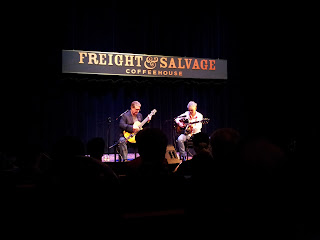
So I skipped my normal practice time to go to this concert and it's totally worthwhile! (And hopefully I would win the drawing I entered for the Peerless Martin Taylor signature model Virtuoso archtop guitar that is being given away! He played the same model last night.)
The set started with Mimi Fox playing solo guitar. I've listened to her latest album so I knew what to expect but still it's much better watching her live. It's cool to watch her right-hand technique: hybrid picking with a pick and also the ring finger. Sometimes she would hide her pick and use the thumb to play bass lines on the 6th string while hitting other strings with the middle finger for harmonics. She played mostly her Heritage archtop (I'm familiar with Heritage because Alex Skolnick of Testament also plays Heritage. HK's Tom Lee TST Showroom has a Heritage archtop) and also a flattop acoustic with a vintage/custom look, which is not a common choice for jazzers) She played "500 Miles High" (a Chick Corea tune and also a hint for the other concert I went to :P) on it. Other memorable pieces included Wes Montgomery's "Four on Six", "Moonlight in Vermont" and Beatle's "She's Leaving Home" from Sgt. Pepper.
Then came Martin Taylor. His style was quite different from Mimi Fox. His playing was more "densed" than Mimi Fox, meaning he played more chords (using the "latin" fingerstyle patterns taught in Berklee Chord 201!) and had a heavier emphasis on the rhythm parts. This video of him (from his younger days) explained it well:
In fact, he did play "I Got Rhythm" last night! I didn't just enjoy the music but also learned a great deal. I think I get a better understanding of his "scaffolding with the 10th" idea watching him demonstrating it in person moving up and down the guitar neck. It seems quite straightforward to apply too: if you could play the chords of a tune in drop-2/drop-3, the thirds (or the 10ths) would be quite obvious on the neck. He made melodies out of these quite a bit. Another idea I saw him using was embellishing the original melody, like what he did with "Georgia on My Mind." Coincidentally, it's the same idea Mimi Fox taught in the book I linked to above! Of course there are a lot more to learn from Mimi Fox's performance too, like her repeat usages of sequences against different chords in the progression (taught in Berklee Jazz 201 Week 3)
Finally, they jammed together on "Blue Bossa" (a must-learn tune for any jazz guitarist. In fact, it's the 2nd tune to improv on at JB's old guitar institute. I wonder if it's still the same for his current school!) and then "Blues for Two" written by Fox (can you believe the topic of this week's class at Berklee's Jazz 201 is blues? Yes, they did substitute quite a few chords of the basic 12-bar blues form!) I actually like Martin Taylor's playing more in this setting where he played more single-note lines while Mimi Fox was comping.

So I skipped my normal practice time to go to this concert and it's totally worthwhile! (And hopefully I would win the drawing I entered for the Peerless Martin Taylor signature model Virtuoso archtop guitar that is being given away! He played the same model last night.)
Sunday, April 21, 2013
我的結他雜記: Wrong note?
The worst fear in me regarding improvisation is playing wrong notes. I spent a lot of time learning what scale/lick works with which chord. I worried about playing them wrong. Oh well, are wrong notes that bad? I bet everyone has tried correcting a wrong note by playing the right note next and found that the end result didn't sound that bad. In fact, the great bassist and teacher Victor Wooten said something really simple but may not be obvious: "You are never more than a half-step away from the right note!" Check out this video in which he explained:
And in this video he actually played a solo using all wrong notes and sounded good!
And in this video he actually played a solo using all wrong notes and sounded good!
Wednesday, March 27, 2013
我的結他雜記: Decoding KORG
I have been using my KORG Pandora PX5D for years with the presets only but I've decided to really look into its amp modelling capability. It used a bunch of cryptic names. I guess it's because KORG doesn't want to pay the original manufacturers the right to use their trademarks.
This is what I was able to guess and google:
This is what I was able to guess and google:
- TWD1X12 1x12” guitar combo covered in tweed cloth, should be Fender Tweed Deluxe
- TWD4X10 4x10 guitar combo but designed for bass guitar, should be Fender Bassman
- BLK2X12 2x12 guitar combo indispensable for country or blues players, could be Fender Twin Reverb
- UKBLUES UK-manufactured vintage stack guitar amp head, could be Marshall 1962 Bluesbreaker
- US HI-G 100 W guitar amp head covered in snake skin from 1991, could be Mesa Boogie Mark IV.
- US MDN High-gain guitar amp with an eye-catching metal plate, could be Mesa Boogie Dual Rectifier
Monday, March 25, 2013
Geek to Guitar Hero
The title doesn't referred to me, of course, but the great guitarist Alex Skolnick, best known for playing lead in the thrash metal pioneer Testament. This is actually the title of his recently published memoir. In general I don't read much biography but I did read a few about musicians, including Miles Davis, John Coltrane and Jimi Hendrix (I still remember I had to kill time while waiting for female classmates at the library so I picked up Miles' biography) This is a little different because Skolnick is still alive and wrote the whole thing by himself. Testament is one of my all-time favourite band. I "discovered" them after listening to Metallica and Slayer and magazines raved about them being a thrash metal band of the same caliber. Their album at the time was "Souls of Black" and I was immediately hooked and bought their prior and subsequent releases. Alex Skolnick's unique style of guitar solo was one of the reasons I'm attracted to their music. And I subscribed to his Facebook page, on which he promoted his book. I wanted to read about the beginnings of his band and his guitar study and the book certainly didn't disappoint.
The book basically covered his childhood (not a very happy one because he didn't fit in with his family and school) to present, primarily focusing on his experiences from his first stint with Testament. I felt somewhat connected to his stories because he grew up in the SF bay area (Berkeley) He mentioned a lot of local places (e.g. Yoshi's!) and bands that I'm familiar with.
There are quite a few episodes that I found most interesting from this book:
When Alex asked for advices from his guitar teacher Joe Satriani whether he should join Legacy (renamed to Testament later because the name was taken already), Satch encouraged him to just play like himself. So he decided to bring the standards of the best hard rock guitarist that inspired his playing to thrash metal, which he initially didn't think his style would fit in. And he did it!
Even though I think "Souls of Black" is an ass-kicking album (may not be as good as "Practice What You Preached" but close), Alex didn't like it that much. He revealed that they did the album just to get enough money from the record company to support their touring. And he thought it's a step back from "Practice" that they should not have made. Rushing to do "Souls" might have cost them the opportunity to become as successful as the "Big 4" (of thrash metal: Metallica, Slayer, Megadeth and Anthrax) In fact, according to Alex, the band wasn't as successful as I imagined. They played in a lot of small clubs after their heydays of playing in big arenas, mostly opening for the biggest names in metal. Now I remember going to one of Testament's concert at a small SF venue called Trocadero Transfer in mid-90s. They certainly made less money than I thought. Alex mentioned few guys from the scene were able to afford buying houses in the bay area. You see sports car in rock music videos a lot but he was no where close to buying his dream Ferrari. After his Pontiac Firebird was stolen, he drove a Corolla instead and sang high praises for it! My experiences with cars is a parallel to his: going from a sports car to a compact car that is also based on Corolla :P
His book mentioned a few lesser-known but great jazz guitarist: like Lenny Breau and Tuck Andress (p.286) I first learned about Lenny Breau while driving in Toronto and listened to its local jazz radio station several years ago. His style was so fascinating that I had to look him up on internet once I got to my sis' place.
Alex wrote some of Testament's early songs using the less-common scale (actually, mode) Mixolydian b2 b6, taught by Satriani earlier. I learned this from Berklee and they call it Mixolydian b9 b13 (b9 is the same as b2 and b13=b6) and wrote a post about its fingering here.
He mentioned there was a song for which he came up with a rhythm guitar part that both he and the other guitarist in the band (Eric) couldn't play well and the producer almost hired a session player for the recording!
A few more things we have in common: we both enjoy the writing of Haruki Murakami. Alex quoted Murakami in his book. We both disliked the disappearance of guitar solo from metal during the grunge era. It's one thing to have your own style that doesn't rely on guitar solo. It's another to imitate bands that don't have guitar solo because you can't pull it off anyway. We both moved to New York, even though in my case, it was just a year but there's no better place for a jazz guy than NYC.
His book actually didn't say much about what happened after he left Testament. I found out he recorded quite a bit of music, for example, with violinist Joe Deninzon on an album titled "The Adventures Of Stratospheerius", and formed the fusion band Attention Deficit that released 2 albums.
I wish he wrote a bit more about his days at Newschool studying jazz but he was living a low-profile life then and may not have much interesting stories for most readers. Nevertheless, it's a fun read. Highly recommended!
The book basically covered his childhood (not a very happy one because he didn't fit in with his family and school) to present, primarily focusing on his experiences from his first stint with Testament. I felt somewhat connected to his stories because he grew up in the SF bay area (Berkeley) He mentioned a lot of local places (e.g. Yoshi's!) and bands that I'm familiar with.
There are quite a few episodes that I found most interesting from this book:
When Alex asked for advices from his guitar teacher Joe Satriani whether he should join Legacy (renamed to Testament later because the name was taken already), Satch encouraged him to just play like himself. So he decided to bring the standards of the best hard rock guitarist that inspired his playing to thrash metal, which he initially didn't think his style would fit in. And he did it!
Even though I think "Souls of Black" is an ass-kicking album (may not be as good as "Practice What You Preached" but close), Alex didn't like it that much. He revealed that they did the album just to get enough money from the record company to support their touring. And he thought it's a step back from "Practice" that they should not have made. Rushing to do "Souls" might have cost them the opportunity to become as successful as the "Big 4" (of thrash metal: Metallica, Slayer, Megadeth and Anthrax) In fact, according to Alex, the band wasn't as successful as I imagined. They played in a lot of small clubs after their heydays of playing in big arenas, mostly opening for the biggest names in metal. Now I remember going to one of Testament's concert at a small SF venue called Trocadero Transfer in mid-90s. They certainly made less money than I thought. Alex mentioned few guys from the scene were able to afford buying houses in the bay area. You see sports car in rock music videos a lot but he was no where close to buying his dream Ferrari. After his Pontiac Firebird was stolen, he drove a Corolla instead and sang high praises for it! My experiences with cars is a parallel to his: going from a sports car to a compact car that is also based on Corolla :P
His book mentioned a few lesser-known but great jazz guitarist: like Lenny Breau and Tuck Andress (p.286) I first learned about Lenny Breau while driving in Toronto and listened to its local jazz radio station several years ago. His style was so fascinating that I had to look him up on internet once I got to my sis' place.
Alex wrote some of Testament's early songs using the less-common scale (actually, mode) Mixolydian b2 b6, taught by Satriani earlier. I learned this from Berklee and they call it Mixolydian b9 b13 (b9 is the same as b2 and b13=b6) and wrote a post about its fingering here.
He mentioned there was a song for which he came up with a rhythm guitar part that both he and the other guitarist in the band (Eric) couldn't play well and the producer almost hired a session player for the recording!
A few more things we have in common: we both enjoy the writing of Haruki Murakami. Alex quoted Murakami in his book. We both disliked the disappearance of guitar solo from metal during the grunge era. It's one thing to have your own style that doesn't rely on guitar solo. It's another to imitate bands that don't have guitar solo because you can't pull it off anyway. We both moved to New York, even though in my case, it was just a year but there's no better place for a jazz guy than NYC.
His book actually didn't say much about what happened after he left Testament. I found out he recorded quite a bit of music, for example, with violinist Joe Deninzon on an album titled "The Adventures Of Stratospheerius", and formed the fusion band Attention Deficit that released 2 albums.
I wish he wrote a bit more about his days at Newschool studying jazz but he was living a low-profile life then and may not have much interesting stories for most readers. Nevertheless, it's a fun read. Highly recommended!
Thursday, February 14, 2013
Live music = Excitement!
Took a break from live music because of holidays and my trip back home (other than jamming with friends) but resumed last month as soon as I was back. The SFJAZZ center, the first one dedicated to jazz in US, opened last month. Too bad I have yet to visit it or attended any concert from the opening week and after :( On that 1/25 and 1/26 weekend, there were actually several appealing concerts, including the ones at SFJAZZ, the International guitar night (featuring the great guitarist and educator Martin Taylor) but I had to pick the one by Joe Lovano US Five. Saxophonist Joe Lovano is THE most prominent jazz musician today IMO. His new releases of recent years have all been exciting: with new compositions and young players, including the charming bassist (who also sings vocal with her own group but not US Five) Esperanza Spalding and an unusual duo of drummers. Check out these video:
Why two drummers? I brought it up with my drummer buddy and he wasn't impressed but a NPR blog post has a deep discussion on this very topic.
For a fan of jazz and Chinese music like me, Ultra World-Xtet's music combined the best of both worlds! I decided I had to go to their concert after watching Gary Schwantes' solo on YouTube.
He is the band leader (saxophonist and dizi player) I've never seen a Westerner playing dizi, the Chinese flute, which was also the first instrument I seriously trying to learn. The rest of the group played drums, bass, guzheng and yangqin, respectively. Some might imagine the awkwardness of fitting the sound of Chinese instrument to jazz music but there was none. It sounded very natural, like they are supposed to be played together. I found both guzheng and yangqin players to be masters in playing Chinese music on their instrument but at the same time adopted quite a bit of improvisation skills from jazz. The encore was the Chinese-new-year-of-Snake-appropriate "Golden Snake Dance." (Yeah, everyone who played Chinese music have learned it)
我的結他雜記:Improvisation with arpeggios
In addition to practicing licks, arpeggios are also part of my daily routine. I understand their importance. The million dollar question in my mind has been: how am I supposed to apply them during improvisation? I've recently come across two helpful resources:
- Making Music from Arpeggios: a free lesson written by Will Kriski
- 25 Major ii-V-I licks for Jazz Guitar: an e-book written by Joseph Alexander. Even though all are 3-4 bar licks, the author made it quite clear how the notes came from arpeggios.
Thursday, January 31, 2013
我的結他雜記: Chordal Pattern System
I just watched this video about a system for learning jazz guitar:
The reason I mentioned this is I think it is related to my current studies: (1) the "old-school" way of Robert Conti who taught licks, complete solo as well as the underlying rationale/tricks. For example, it mentioned the "move up 3 frets" trick taught by Conti. And (2) the theory-centric way of Berklee from which I'm taking a class on chords (not just 4-note 7th chord but a lot of triads too)
I am reading his blog.
The reason I mentioned this is I think it is related to my current studies: (1) the "old-school" way of Robert Conti who taught licks, complete solo as well as the underlying rationale/tricks. For example, it mentioned the "move up 3 frets" trick taught by Conti. And (2) the theory-centric way of Berklee from which I'm taking a class on chords (not just 4-note 7th chord but a lot of triads too)
I am reading his blog.
Wednesday, December 05, 2012
A Day full of Jazz
I listen to a fair amount of music everyday but this day was special. First of all, I read about the bad news of jazz great, pianist Dave Brubeck passing away, one day before his 92nd birthday, via none other than the Facebook feed of classical radio station KDFC! The Dave Brubeck Quartet's original, "Take Five", was considered as the most well-known jazz tune ever. Jazz station KCSM played an interview of him after work. I learned quite a few things from the 10 minutes I listened to it: 1) at one time he had a bad relationship with Paul Desmond, the then-future saxophonist of his quartet who would compose "Take Five." 2) they started the trend of jazz musicians playing concerts at colleges which were more accessible to students because of less expensive tickets and the need to drive or take a bus. I was a beneficiary of this myself: one of the very first jazz shows I attended was at the student union at UT: a Stanley Jordan solo performance. Later that night I listened to the radio show Piano jazz hosted by Marian McPartland on KCSM with guitarist Russell Malone. He talked about the first time he played on stage with Jimmy Smith. He tried to show off his skills but got a lesson from Smith, which was very interesting. Malone offered some advices during the show as well: he suggested instrumentalists to learn tunes by listening to vocalist and paying attention to lyrics for phrasing and interpretation. That was during my drive to Yoshi's to see veteran guitarist Lee Ritenour and his special guest Mike Stern. I am kinda familiar with Stern's fusion style and "signature" sound (on a Fender Telecaster) through previous live performances and his albums. I have listened to Ritenour's playing on the "smooth jazz supergroup" Fourplay (which has its fair shares of criticism for playing it safe) as well as his "6 String Theory" album that featured an "all-star" lineup of guest guitarists. He played 3 different guitars during the show: a Yamaha "Silent" nylon string guitar (for acoustic tunes), a Gibson L5 Archtop (for traditional jazz) and a Les Paul (for rock/fusion). Obviously there were lots of variety during the show. They played quite a few songs from Ritenour's new album called "Rhythm Sessions", which featured several different rhythm sessions (bass/drums). I can't believe the full listing of songs and personnel is so hard to find though! I listened to the whole album on Rhapsody and it is quite enjoyable.
Tuesday, November 20, 2012
Is Smooth Jazz Dead?
I didn't come up with the title. I simply took it from an article in the JazzTimes magazine (discussed here on the Saxophone music forum.) I am really surprised that a type of music that is trying to please everyone and offend no one could go downhill like this [link1, link2] (I was equally surprised when the radio station KKSF dropped the smooth jazz format) I guess the moral of the story is that musicians just need to be themselves and play without worrying about offending or pleasing some audiences. Good players will always find way to be heard, with the smooth jazz moniker or not. (Look at David Sanborn) On the other hand, less talented folks who rode on coattails of others won't last long.
Thursday, November 15, 2012
Electric blues compilation
I have been a big fan of electric blues since the first time I listened to SRV years ago. Just read about a new 12-CD compilation from the Guitar Player magazine. I was in the mood for some blues and listened to some Lightnin' Hopkins 2 weeks ago. What a coincidence!
Wednesday, November 14, 2012
我的結他雜記: The Pentatonic Jazz improvisation system
Check out this video for a good demo of the system:
I came across it from this forum post. Following this system, you won't play any note that doesn't "go along" with the harmony. His fingering is always 2 notes per string, which is "classic" pentatonic fingering. His system has many many fingerings though. Some also said jazz was about playing the "wrong notes" On the other hand, it has a lot of appeal to players like me who are unable to improvise at all with so many note and scale choices. He used only 1 fingering (moved for different keys) in the above demo and it sounds pretty good already.
I came across it from this forum post. Following this system, you won't play any note that doesn't "go along" with the harmony. His fingering is always 2 notes per string, which is "classic" pentatonic fingering. His system has many many fingerings though. Some also said jazz was about playing the "wrong notes" On the other hand, it has a lot of appeal to players like me who are unable to improvise at all with so many note and scale choices. He used only 1 fingering (moved for different keys) in the above demo and it sounds pretty good already.
Tuesday, November 13, 2012
Current landscape of cloud music service
Yes, I intentionally made the title sounded like some sort of research/report from the likes of Gartner. Well, it was 5 years ago last time I wrote a related post. The buzzword "cloud" wasn't as big back then and the industry still refered to streaming services like Rhapsody and Napster as "subscription" Lots have changed though between these 5 years besides of the name. I'm still a user of such service (back to Rhapsody after Yahoo Music Unlimited was shutdown in 2008) but haven't paid much attention to the health of this business until today. I've found:
1) Rhapsody was spun off by Real Network (and partner MTV Network) as an independent company (Real still owns some stakes) in 2010
2) Rhapsody celebrated its 10th anniversary, reached one million subscribers and on track to become profitable last year according to this. The growth was credited to popularities of competitors like Spotify and support on portable devices like iOS and Android tablet/phones.
3) Among the providers I mentioned in my 2007 post, only 2 remained: Rhapsody bought Napster from BestBuy last year. MTV's Urge merged with Rhapsody in 2007. Microsoft's Zune Pass will become Xbox Music soon. And I already mentioned Yahoo shutdown its service in 2008.
Lots of techie disliked Real Network because of its practices (Real Player installations related) in the early dot-com days so I guess not longer associating with it is a good thing for Rhapsody to some potential customers. It seemed quite amazing to me that a business could survive for 10 years while struggling with profitability. It is also surprising that the appearance of a heavily hyped upstart like Spotify actually revitalize the whole sector ("grown the cake" if you will) and benefited "old timers" in the sector like Rhapsody. Hey, anything that's associated with "the cloud" is cool, especially after Apple created iCloud, isn't it? I guess it showed that Rhapsody was way ahead (9+ years) of its time. I certainly would not blame its lack of success on its technology. Not sure how many people knew and remembered the whole saga of Harmony DRM back in 2004 (BTW, finally a class action lawsuit was filed against Apple recently). Rhapsody created Harmony so that their tracks (purchased by user only, not the subscription ones) could play on iPod. Of course, Apple being Apple wouldn't allow this to happen and patched this "loophole" during the next release of firmware. At that point I thought Rhapsody could make a great move by releasing its own iPod firmware that works with both purchased and subscription tracks! (They don't even have to do it officially. Just leak it and claimed it's a hack by the user community!) Well, things come full circle when Apple finally approved Rhapsody's iOS app years later, which works for both types of tracks. IIn fact, the app was another boost to Rhapsody's growth. Looks like this industry is in good shape and we could all go back to enjoying great music.
1) Rhapsody was spun off by Real Network (and partner MTV Network) as an independent company (Real still owns some stakes) in 2010
2) Rhapsody celebrated its 10th anniversary, reached one million subscribers and on track to become profitable last year according to this. The growth was credited to popularities of competitors like Spotify and support on portable devices like iOS and Android tablet/phones.
3) Among the providers I mentioned in my 2007 post, only 2 remained: Rhapsody bought Napster from BestBuy last year. MTV's Urge merged with Rhapsody in 2007. Microsoft's Zune Pass will become Xbox Music soon. And I already mentioned Yahoo shutdown its service in 2008.
Lots of techie disliked Real Network because of its practices (Real Player installations related) in the early dot-com days so I guess not longer associating with it is a good thing for Rhapsody to some potential customers. It seemed quite amazing to me that a business could survive for 10 years while struggling with profitability. It is also surprising that the appearance of a heavily hyped upstart like Spotify actually revitalize the whole sector ("grown the cake" if you will) and benefited "old timers" in the sector like Rhapsody. Hey, anything that's associated with "the cloud" is cool, especially after Apple created iCloud, isn't it? I guess it showed that Rhapsody was way ahead (9+ years) of its time. I certainly would not blame its lack of success on its technology. Not sure how many people knew and remembered the whole saga of Harmony DRM back in 2004 (BTW, finally a class action lawsuit was filed against Apple recently). Rhapsody created Harmony so that their tracks (purchased by user only, not the subscription ones) could play on iPod. Of course, Apple being Apple wouldn't allow this to happen and patched this "loophole" during the next release of firmware. At that point I thought Rhapsody could make a great move by releasing its own iPod firmware that works with both purchased and subscription tracks! (They don't even have to do it officially. Just leak it and claimed it's a hack by the user community!) Well, things come full circle when Apple finally approved Rhapsody's iOS app years later, which works for both types of tracks. IIn fact, the app was another boost to Rhapsody's growth. Looks like this industry is in good shape and we could all go back to enjoying great music.
Thursday, November 08, 2012
我的結他雜記: 即興道
Monday, November 05, 2012
It runs in the family
Listened to a bunch of "new" jazz music last weekend (some of them are released recently while others are just discovered by me) The common and interesting theme is that all of them comes from musical families. The first CD is "Spirit Fiction" by saxophonist Ravi Coltrane, whose father is one of the most important musician in the history of jazz, as most people already know, the late great John Coltrane. John Coltrane died when Ravi was 2 and obviously didn't gave him any input in terms of music directly (On the other hand, every jazz player must have been influenced by John Coltrane one way or the other) Ravi has his unique sound and this CD is one of the his best. The 2nd CD is "Colombe" by guitarist David Reinhardt. Again, he has an instantly recognizable last name from his grandfather, the legendary Gypsy jazz guitarist Django Reinhardt. David also doesn't sound like his grandpa. He plays in a organ trio setting on this CD. The next musician, saxophonist Von Freeman, is different in the sense that I've actually listened to his son, Chico Freeman, before I listened to him. Finally, I discovered a CD by jazz ukulele player Lyle Ritz, "A Night of Ukulele jazz/Live at McCabe's," on which his daughter Emily has also performed.
Subscribe to:
Posts (Atom)